President-elect Barack Obama tapped Gov. Bill Richardson to be Commerce Secretary.
See the press conference here:
Wednesday, December 3, 2008
Monday, December 1, 2008
Obama Announces National Security Team
From the transition's email to supporters:
"Hillary Clinton, U.S. Senator from New York and former First Lady, will serve as Secretary of State.Here's the video of the press conference:
Secretary Robert Gates, the current Secretary of Defense, will continue to serve in that role.
Eric Holder, former Deputy Attorney General and a former United States Attorney for the District of Columbia, will serve as Attorney General.
Janet Napolitano, Governor and former U.S. Attorney for Arizona, will serve as Secretary of the Department of Homeland Security.
Dr. Susan E. Rice, a Senior Foreign Policy Advisor to the Obama for America campaign, a Senior Fellow at the Brookings Institution, and former U.S. Assistant Secretary of State for African Affairs, will serve as Ambassador to the United Nations.
General Jim Jones, USMC (Ret), former Allied Commander, Europe, and Commander of the United States European Command, will serve as National Security Advisor."


Wednesday, November 26, 2008
Obama Team on Mumbai Attacks
(CNN) — The Obama Transition team's chief national security spokesperson, Brooke Anderson, released a statement late Wednesday reacting to the attacks in Mumbai, India:
"President-Elect Obama strongly condemns today's terrorist attacks in Mumbai, and his thoughts and prayers are with the victims, their families, and the people of India. These coordinated attacks on innocent civilians demonstrate the grave and urgent threat of terrorism. The United States must continue to strengthen our partnerships with India and nations around the world to root out and destroy terrorist networks. We stand with the people of India, whose democracy will prove far more resilient than the hateful ideology that led to these attacks.”
Source: CNN.com
"President-Elect Obama strongly condemns today's terrorist attacks in Mumbai, and his thoughts and prayers are with the victims, their families, and the people of India. These coordinated attacks on innocent civilians demonstrate the grave and urgent threat of terrorism. The United States must continue to strengthen our partnerships with India and nations around the world to root out and destroy terrorist networks. We stand with the people of India, whose democracy will prove far more resilient than the hateful ideology that led to these attacks.”
Source: CNN.com
Tuesday, November 25, 2008
Obama Adds to the Economic Team
In a press conference today, President-Elect names Peter Orszag as Office of Management and Budget Director, and Robert Nabors as Deputy Director.
Orszag (pictured below) is currently the director of the Congressional Budget Office, and was an economic advisor to Bill Clinton. CNNMoney.com has a nice summary.

Nabors (pictured below) is Democratic staff director in the House Appropriations Committee, and a former Office of Management and Budget official.

Orszag (pictured below) is currently the director of the Congressional Budget Office, and was an economic advisor to Bill Clinton. CNNMoney.com has a nice summary.

Nabors (pictured below) is Democratic staff director in the House Appropriations Committee, and a former Office of Management and Budget official.

Monday, November 24, 2008
Obama Announces Economic Team
In a press conference in Chicago, President-Elect Obama announced his nominations for his economic team:
- Timothy F. Geithner, Secretary of the Treasury
- Lawrence H. Summers, Director of the National Economic Council
- Christina D. Romer, Director of the Council of Economic Advisors
- Melody C. Barnes, Director of the Domestic Policy Council
Saturday, November 22, 2008
President-Elect Obama's Weekly Address: "Economy -- Of the People, By the People"
"President-elect Barack Obama has directed the Transition's economic team to develop the details of a bold plan to save or create 2.5 million American jobs by 2011."
Source: Obama Transition Website
Source: Obama Transition Website
Saturday, November 15, 2008
A Couple More Insider Appointments
Today, the Obama Transition Team announced two new insider appointments.
Long-time friend and confidante Valerie Jarrett has been named Senior Advisor and Assistant to the President for Intergovernmental Relations and Public Liaison.

Also, Phil Schiliro has been named Assistant to the President for Legislative Affairs

President-elect Barack Obama said, "These individuals will be essential members of our team as we work to bring Republicans and Democrats together to strengthen our struggling economy and make Washington work for all Americans. I have the utmost confidence that their broad and diverse experience will serve my administration and the American people well in the challenging months."
You can read their extensive bios on the Change.gov press release.
Long-time friend and confidante Valerie Jarrett has been named Senior Advisor and Assistant to the President for Intergovernmental Relations and Public Liaison.

Also, Phil Schiliro has been named Assistant to the President for Legislative Affairs

President-elect Barack Obama said, "These individuals will be essential members of our team as we work to bring Republicans and Democrats together to strengthen our struggling economy and make Washington work for all Americans. I have the utmost confidence that their broad and diverse experience will serve my administration and the American people well in the challenging months."
You can read their extensive bios on the Change.gov press release.
Weekly Address from the President-Elect
The Weekly Democratic Address is normally broadcast on radio. It will continue to be, but President-Elect Obama is also doing it as a video on YouTube and elsewhere...call it presidential vlogging.
The most exciting part: President-elect Obama plans to publish these weekly updates through the Transition and then on from the White House. Just think...every week, we'll get a personal address from the president, directly to us, the American people, without that nasty thing the Republicans like to call "the filter of the mainstream media."
In this week's address, Obama addresses the current economic crisis.
Remarks of President-elect Barack Obama
November 15, 2008
Today, the leaders of the G-20 countries -- a group that includes the world's largest economies -- are gathering in Washington to seek solutions to the ongoing turmoil in our financial markets. I'm glad President Bush has initiated this process -- because our global economic crisis requires a coordinated global response.
And yet, as we act in concert with other nations, we must also act immediately here at home to address America's own economic crisis. This week, amid continued volatility in our markets, we learned that unemployment insurance claims rose to their highest levels since September 11, 2001. We've lost jobs for ten straight months -- nearly 1.2 million jobs this year, many of them in our struggling auto industry. And millions of our fellow citizens lie awake each night wondering how they're going to pay their bills, stay in their homes, and save for retirement.
Make no mistake: this is the greatest economic challenge of our time. And while the road ahead will be long, and the work will be hard, I know that we can steer ourselves out of this crisis -- because here in America we always rise to the moment, no matter how hard. And I am more hopeful than ever before that America will rise once again.
But we must act right now. Next week, Congress will meet to address the spreading impact of the economic crisis. I urge them to pass at least a down-payment on a rescue plan that will create jobs, relieve the squeeze on families, and help get the economy growing again. In particular, we cannot afford to delay providing help for the more than one million Americans who will have exhausted their unemployment insurance by the end of this year. If Congress does not pass an immediate plan that gives the economy the boost it needs, I will make it my first order of business as President.
Even as we dig ourselves out of this recession, we must also recognize that out of this economic crisis comes an opportunity to create new jobs, strengthen our middle class, and keep our economy competitive in the 21st century.
That starts with the kinds of long-term investments that we've neglected for too long. That means putting two million Americans to work rebuilding our crumbling roads, bridges, and schools. It means investing $150 billion to build an American green energy economy that will create five million new jobs, while freeing our nation from the tyranny of foreign oil, and saving our planet for our children. It means making health care affordable for anyone who has it, accessible for anyone who wants it, and reducing costs for small businesses. And it also means giving every child the world-class education they need to compete with any worker, anywhere in the world.
Doing all this will require not just new policies, but a new spirit of service and sacrifice, where each of us resolves to pitch in and work harder and look after not only ourselves, but each other. If this financial crisis has taught us anything, it's that we cannot have a thriving Wall Street while Main Street suffers -- in this country, we rise or fall as one nation; as one people. And that is how we will meet the challenges of our time -- together. Thank you.
The most exciting part: President-elect Obama plans to publish these weekly updates through the Transition and then on from the White House. Just think...every week, we'll get a personal address from the president, directly to us, the American people, without that nasty thing the Republicans like to call "the filter of the mainstream media."
In this week's address, Obama addresses the current economic crisis.
Remarks of President-elect Barack Obama
November 15, 2008
Today, the leaders of the G-20 countries -- a group that includes the world's largest economies -- are gathering in Washington to seek solutions to the ongoing turmoil in our financial markets. I'm glad President Bush has initiated this process -- because our global economic crisis requires a coordinated global response.
And yet, as we act in concert with other nations, we must also act immediately here at home to address America's own economic crisis. This week, amid continued volatility in our markets, we learned that unemployment insurance claims rose to their highest levels since September 11, 2001. We've lost jobs for ten straight months -- nearly 1.2 million jobs this year, many of them in our struggling auto industry. And millions of our fellow citizens lie awake each night wondering how they're going to pay their bills, stay in their homes, and save for retirement.
Make no mistake: this is the greatest economic challenge of our time. And while the road ahead will be long, and the work will be hard, I know that we can steer ourselves out of this crisis -- because here in America we always rise to the moment, no matter how hard. And I am more hopeful than ever before that America will rise once again.
But we must act right now. Next week, Congress will meet to address the spreading impact of the economic crisis. I urge them to pass at least a down-payment on a rescue plan that will create jobs, relieve the squeeze on families, and help get the economy growing again. In particular, we cannot afford to delay providing help for the more than one million Americans who will have exhausted their unemployment insurance by the end of this year. If Congress does not pass an immediate plan that gives the economy the boost it needs, I will make it my first order of business as President.
Even as we dig ourselves out of this recession, we must also recognize that out of this economic crisis comes an opportunity to create new jobs, strengthen our middle class, and keep our economy competitive in the 21st century.
That starts with the kinds of long-term investments that we've neglected for too long. That means putting two million Americans to work rebuilding our crumbling roads, bridges, and schools. It means investing $150 billion to build an American green energy economy that will create five million new jobs, while freeing our nation from the tyranny of foreign oil, and saving our planet for our children. It means making health care affordable for anyone who has it, accessible for anyone who wants it, and reducing costs for small businesses. And it also means giving every child the world-class education they need to compete with any worker, anywhere in the world.
Doing all this will require not just new policies, but a new spirit of service and sacrifice, where each of us resolves to pitch in and work harder and look after not only ourselves, but each other. If this financial crisis has taught us anything, it's that we cannot have a thriving Wall Street while Main Street suffers -- in this country, we rise or fall as one nation; as one people. And that is how we will meet the challenges of our time -- together. Thank you.
Friday, November 14, 2008
VP-Elect Joe Biden Chooses His Chief of Staff
 Eight days after Obama picked Rahm Emanuel as his White House Chief of Staff, Vice President-Elect Joe Biden has now selected his own chief of staff: Ron Klain, who was VP Al Gore's chief of staff as well as a senior adviser in Al Gore's 2000 presidential campaign.
Wall Street Journal has the story.
Thursday, November 13, 2008
Obama Resigns His Senate Seat

Big surprise...effective Sunday (11/15/08), Obama will resign his Illinois Senate seat. Guess he's just gonna be too busy being President to be able to be a Senator too. ;-)
It will now be up to Illinois Gov. Rod Blagojevich to appoint his successor, who will serve until 2010.
First Read lists possible candidates as "Reps. Jesse Jackson Jr., Jan Schakowsky and Melissa Bean; Tammy Duckworth, the unsuccessful 2006 House candidate who now heads the Illinois Department of Veterans' Affairs; Illinois Attorney General Lisa Madigan; and State Comptroller Dan Hynes."
Photo: Associated Press
The Truth About Obama's Muslim Faith Finally Revealed in Full Detail

As you probably know, the truth is that Barack Obama is not a Muslim, though he sees and values the common threads at the heart of all religions. (Can you begrudge a Christian the virtue of tolerance?)
Once again, for those of you who are still confused, Barack Obama is a born-again Christian (though he's careful not to claim a monopoly on Truth, and I admire that in a President-elect of a religiously diverse nation that also has a clear and constitutional separation of its church and state).
He details his beliefs, religious influences, and journey to Christ in this 2004 interview republished in full for the first time on Beliefnet.com
Tuesday, November 11, 2008
Secret Service Calls Obama "Renegade"
 Fox News reported today that the Secret Service has assigned its traditional code names for the first family, and here they are:
Barack Obama: Renegade
Wife, Michelle Obama: Renaissance
Daughter Malia Obama: Radiance
Daughter Sasha Obama: Rosebud
And the VP and his wife shall be known as:
Joe Biden: Celtic
Wife, Jill Biden: Capri
NBC News reassured viewers this evening, as did Fox in their report, that the code names serve no security function anymore, and continue today simply as a favorite tradition of the Secret Service. They do their best to come up with great code names, and then release them to the press for broadcast.
Rosebud. Is that just too cute, or what?
Monday, November 10, 2008
The Obamas Visit The White House
The Obamas visited the White House today for the first time. Barack Obama and George Bush talked in the Oval Office together for more than an hour, while Laura Bush gave Michelle Obama a tour of the private residence and the two talked about raising daughters in the White House.
First, here are a few pics.


And here's some news footage of their arrival and the walk down the colonnade.
And live coverage from NBC:
First, here are a few pics.


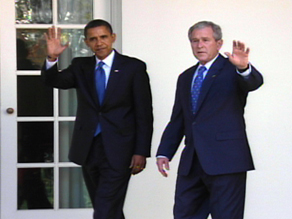
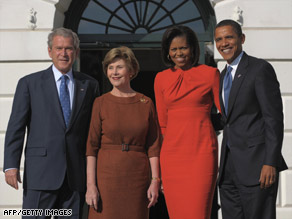
And here's some news footage of their arrival and the walk down the colonnade.
And live coverage from NBC:
Saturday, November 8, 2008
Where's the Pushover the GOP Promised Us?
Throughout the campaign, Obama's detractors suggested Obama would be a foreign policy pushover, talking with adversaries "without preconditions" and making a lot of hay out of Biden's comment that Obama would be tested early.
 So sorry! It's only Obama's fourth day of being President-Elect, and he's already miffed the Iranians with his firm stance, reiterated at his press conference yesterday, that a nuclear Iran is "unacceptable."
And now the Iranians are whining about Obama not being the pushover they hoped for, in a silly attempt to throw his message of change back into his face:
In other foreign policy news, CNN reports that Denis McDonough, Obama's senior foreign policy adviser, has clarified that contrary to a claim on the Polish president's website, Obama is not committed to a missile shield in Eastern Europe.
Russian President Dmitri Medvedev had warned earlier this week that the Russians would respond to the missile shield with missile deployments of their own near Poland.
 So sorry! It's only Obama's fourth day of being President-Elect, and he's already miffed the Iranians with his firm stance, reiterated at his press conference yesterday, that a nuclear Iran is "unacceptable."
And now the Iranians are whining about Obama not being the pushover they hoped for, in a silly attempt to throw his message of change back into his face:
[Parliamentary Speaker] Ali Larijani said Saturday that Obama should apply his campaign message of change to U.S. dealings with Iran.Lesson for the world: Obama is an intelligent, thoughtful leader who will listen respectfully to your point of view and discuss it with you. That's a lot more than Bush ever gave you. But don't think he's going to throw our national security out the window."Obama must know that the change that he talks about is not simply a superficial changing of colors or tactics," Larijani said in comments carried by the semi-official Mehr News Agency.
"What is expected is a change in strategy, not the repetition of objections to Iran's nuclear program, which will be taking a step in the wrong direction."
Source: CNN.com

In other foreign policy news, CNN reports that Denis McDonough, Obama's senior foreign policy adviser, has clarified that contrary to a claim on the Polish president's website, Obama is not committed to a missile shield in Eastern Europe.
Russian President Dmitri Medvedev had warned earlier this week that the Russians would respond to the missile shield with missile deployments of their own near Poland.
Obama Delivers the Weekly Democratic Address
Audio Streaming Source: Politico.com


Full Text of the Address:
On Tuesday, Americans stood in lines that stretched around schools and churches in numbers this nation has never seen. It didn’t matter who they were or where they came from; what they looked like or what party they belonged to – they came out and cast their ballot because they believed that in this country, our destiny is not written for us, but by us. We should all take pride in the fact that we once again displayed for the world the power of our democracy, and reaffirmed the great American ideal that this is a nation where anything is possible.
This week, I spoke with President Bush, who graciously offered his full support and assistance in this period of transition. Michelle and I look forward to meeting with him and the First Lady on Monday to begin that process. This speaks to a fundamental recognition that here in America we can compete vigorously in elections and challenge each other’s ideas, yet come together in service of a common purpose once the voting is done. And that is particularly important at a moment when we face the most serious challenges of our lifetime.
Yesterday, we woke to more sobering news about the state of our economy. The 240,000 jobs lost in October marks the 10th consecutive month that our economy has shed jobs. In total, we’ve lost nearly 1.2 million jobs this year, and more than 10 million Americans are now unemployed. Tens of millions of families are struggling to figure out how to pay the bills and stay in their homes. Their stories are an urgent reminder that we are facing the greatest economic challenge of our lifetime, and we must act swiftly to resolve them.
In the wake of these disturbing reports, I met with members of my Transition Economic Advisory Board, who will help guide the work of my transition team in developing a strong set of policies to respond to this crisis. While we must recognize that we only have one President at a time and that President Bush is the leader of our government, I want to ensure that we hit the ground running on January 20th because we don’t have a moment to lose.
We discussed several of the most immediate challenges facing our economy and key priorities on which to focus in the days and weeks ahead to ease the credit crisis, help hardworking families, and restore growth and prosperity.
First, we need a rescue plan for the middle class that invests in immediate efforts to create jobs and provides relief to families that are watching their paychecks shrink and their life savings disappear.
Then, we’ll address the spreading impact of the financial crisis on other sectors of our economy, and ensure that the rescue plan that passed Congress is working to stabilize financial markets while protecting taxpayers, helping homeowners, and not unduly rewarding the management of financial firms that are receiving government assistance.
Finally, we will move forward with a set of policies that will grow our middle-class and strengthen our economy in the long-term. We can’t afford to wait on moving forward on the key priorities that I identified during the campaign, including clean energy, health care, education and tax relief for middle class families.
Let me close by saying I do not underestimate the enormity of the task that lies ahead. We’ve taken some major actions to date, and we will need further actions during this transition and subsequent months. Some of those choices will be difficult, but America is a strong and resilient country. I know that we will succeed if we put aside partisanship and work together as one nation. And that is what I intend to do.
MP3 Download and Transcript Source: The Democratic Party
Friday, November 7, 2008
Obama holds his first press conference as President-Elect
Obama's remarks focus on his top priority, which is the same priority of the voters who sent him to the White House: the economy.
He's not the President yet, so he's a little hamstrung, and there's not a lot he can do himself yet. But he did call for a second stimulus package for the American people, which he said would be his first task as President, if it's not done sooner, which is what he hopes for.
(By the way, in the "Agenda" portion of the transition website, under the heading "Revitalizing the Economy," one finds reference to an Obama/Biden strategy to provide a $1,000 emergency energy rebate to Americans, paid for with a windfall profits tax on excessive oil company profits...that socialist sure doesn't waste any time, does he? But then, Sarah Palin does the same thing in Alaska, so I guess it's ok.)
Most interesting item in the press conference to me: He hedges a bit on raising taxes on upper-income Americans. (17:45 mark) Interesting...
Today he got his first "President-Elect version" of the PDB (President's Daily Briefing), the daily intelligence briefing normally delivered to the chief executive, which I heard he received at an FBI office in Chicago. He couldn't tell us anything about it, or he'd have to kill us.
My favorite line: "With respect to the dog [to be chosen for the Obama children], this is a major issue." (15:30 mark, based on question at 14:00 mark)
I love his dry sense of humor, able to talk as seriously and with as much thoughtfulness about the choice of a family dog as he does about fixing the economy. (And choosing the First Fido is important; you want a reliable guard dog who will keep the nasty paparazzi at bay, as the Bush dog Barney faithfully did yesterday.)
Courtesy of CSPAN and YouTube, here's the video of Obama's press conference today:
P.S. Obama had to call Nancy Reagan and apologize for his slightly mocking comment about her and seances, which he made at around 14:50. Reports are that the two had a warm conversation; sounds like Nancy took it in stride, and was as gracious as ever.
You can read a quick summary of the press conference here:
http://firstread.msnbc.msn.com/archive/2008/11/07/1663473.aspx
Full Transcript of the Press Conference:
Obama: Thank you very much, everybody. Thank you very much.
This morning, we woke up to more sobering news about the state of our economy. The 240,000 jobs lost in October marks the 10th consecutive month that our economy has shed jobs. In total, we've lost nearly 1.2 million jobs this year, and more than 10 million Americans are now unemployed.
Tens of millions of families are struggling to figure out how to pay the bills and stay in their homes. Their stories are an urgent reminder that we are facing the greatest economic challenge of our lifetime, and we're going to have to act swiftly to resolve it.
Now, the United States has only one government and one president at a time. And until January 20th of next year, that government is the current administration.
I've spoken to President Bush. I appreciate his commitment to ensuring that his economic policy team keeps us fully informed as developments unfold. And I'm also thankful for his invitation to the White House.
Immediately after I become president, I'm going to confront this economic crisis head on by taking all necessary steps to ease the credit crisis, help hardworking families, and restore growth and prosperity.
And this morning, I met with members of my Transition Economic Advisory Board, who are standing behind me, alongside my vice president-elect, Joe Biden.
They will help to guide the work of my transition team, working with Rahm Emanuel, my chief of staff, in developing a strong set of policies to respond to this crisis. We discussed in the earlier meeting several of the most immediate challenges facing our economy and key priorities on which to focus on in the days and weeks ahead.
First of all, we need a rescue plan for the middle class that invests in immediate efforts to create jobs and provide relief to families that are watching their paychecks shrink and their life savings disappear.
A particularly urgent priority is a further extension of unemployment insurance benefits for workers who cannot find work in the increasingly weak economy.
A fiscal stimulus plan that will jump-start economic growth is long overdue. I've talked about it throughout this -- the last few months of the campaign. We should get it done.
Second, we have to address the spreading impact of the financial crisis on the other sectors of our economy: small businesses that are struggling to meet their payrolls and finance their holiday inventories; and state and municipal governments facing devastating budget cuts and tax increases.
We must also remember that the financial crisis is increasingly global and requires a global response.
The news coming out of the auto industry this week reminds us of the hardship it faces, hardship that goes far beyond individual auto companies to the countless suppliers, small businesses and communities throughout our nation who depend on a vibrant American auto industry.
The auto industry is the backbone of American manufacturing and a critical part of our attempt to reduce our dependence on foreign oil.
I would like to see the administration do everything it can to accelerate the retooling assistance that Congress has already enacted. In addition, I have made it a high priority for my transition team to work on additional policy options to help the auto industry adjust, weather the financial crisis, and succeed in producing fuel-efficient cars here in the United States of America.
And I was glad to be joined today by Governor Jennifer Granholm, who obviously has great knowledge and great interest on this issue.
I've asked my team to explore what we can do under current law and whether additional legislation will be needed for this purpose.
 Third, we will review the implementation of this administration's financial program to ensure that the government's efforts are achieving their central goal of stabilizing financial markets while protecting taxpayers, helping homeowners, and not unduly rewarding the management of financial firms that are receiving government assistance.
It is absolutely critical that the Treasury work closely with the FDIC, HUD, and other government agencies to use the substantial authority that they already have to help families avoid foreclosure and stay in their homes.
Finally, as we monitor and address these immediate economic challenges, we will be moving forward in laying out a set of policies that will grow our middle class and strengthen our economy in the long term. We cannot afford to wait on moving forward on the key priorities that I identified during the campaign, including clean energy, health care, education, and tax relief for middle-class families.
My transition team will be working on each of these priorities in the weeks ahead, and I intend to reconvene this advisory board to discuss the best ideas for responding to these immediate problems.
Let me close by saying this. I do not underestimate the enormity of the task that lies ahead. We have taken some major action to date, and we will need further action during this transition and subsequent months.
Some of the choices that we make are going to be difficult. And I have said before and I will repeat again: It is not going to be quick, and it is not going to be easy for us to dig ourselves out of the hole that we are in.
But America is a strong and resilient country. And I know we will succeed, if we put aside partisanship and politics and work together as one nation. That's what I intend to do.
With that, let me open it up for some questions. And I'm going to start right here with you.
Question: Thank you, Mr. President-elect. I wonder what you think any president can accomplish during their first 100 days in office to turn the economy around? How far can you go? And what will be your priorities on day one?
Obama: Well, I think that a new president can do an enormous amount to restore confidence, to move an agenda forward that speaks to the needs of the economy and the needs of middle-class families all across the country.
I've outlined during the course of the campaign some critical issues that I intend to work on.
We have a current financial crisis that is spilling out into rest of the economy, and we have taken some action so far. More action is undoubtedly going to be needed. My transition team is going to be monitoring very closely what happens over the course of the next several months.
The one thing I can say with certainty is that we are going to need to see a stimulus package passed either before or after inauguration.
We are going to have to focus on jobs, because the hemorrhaging of jobs has an impact, obviously, on consumer confidence and the ability of people to -- to buy goods and services and can have enormous spillover effects.
And I think it's going to be very important for us to provide the kinds of assistance to state and local governments to make sure that they don't compound some of the problems that are already out there by having to initiate major layoffs or initiate tax increases.
So there are some things that we know we're going to have to do, but I'm confident that a new president can have an enormous impact. That's why I ran for president.
Question: (off-mike) ... from House Democrats that the stimulus package may be in trouble, that it's going to be a hard time getting out of a lame-duck session. Are you still confident that you would be able to get something done before you actually take office?
Obama: I want to see a stimulus package sooner rather than later. If it does not get done in the lame-duck session, it will be the first thing I get done as president of the United States.
Question: Senator, for the first time since the Iranian revolution, the president of Iran sent a congratulations note to a new U.S. president. I'm wondering if, first of all, if you responded to President Ahmadinejad's note of congratulations and, second of all, and more importantly, how soon do you plan on sending low-level envoys to countries such as Iran, Syria, Venezuela, Cuba, to see if a presidential-level talk would be productive?
Obama: I am aware that the letter was sent. Let me state -- repeat what I stated during the course of the campaign.
Iran's development of a nuclear weapon I believe is unacceptable. And we have to mount a international effort to prevent that from happening.
Iran's support of terrorist organizations I think is something that has to cease.
I will be reviewing the letter from President Ahmadinejad, and we will respond appropriately. It's only been three days since the election. Obviously, how we approach and deal with a country like Iran is not something that we should, you know, simply do in a knee- jerk fashion. I think we've got to think it through.
But I have to reiterate once again that we only have one president at a time. And I want to be very careful that we are sending the right signals to the world as a whole that I am not the president and I won't be until January 20th.
Question: Picking up what we were just talking about, your meeting with President Bush on Monday. When -- he is still the decider, obviously, stating the obvious. When you disagree with decisions he makes, will you defer? Will you challenge? Will you confront? And if it becomes confrontational, could that rattle the markets even more?
Obama: Well, President Bush graciously invited Michelle and I to -- to meet with him and First Lady Laura Bush. We are gratified by the invitation. I'm sure that, in addition to taking a tour of the White House, there's going to be a substantive conversation between myself and the president.
I'm not going to anticipate problems. I'm going to go in there with a spirit of bipartisanship and a sense that both the president and various leaders in Congress all recognize the severity of the situation right now and want to get stuff done.
And, you know, undoubtedly there may end up being differences between not just members of different parties, but between people within the same party.
The critical point and I think the critical tone that has to be struck by all of us involved right now is the American people need help. This economy is in bad shape. And we have just completed one of the longest election cycles in recorded history.
Now is a good time for us to set politics aside for a while and think practically about what will actually work to move the economy forward. And it's in that spirit that I'll have the conversation with the president.
Question: Thank you, Mr. President-elect. With the country facing two wars and a financial crisis, do you think it's important for you to move especially quickly to fill key cabinet posts, such as treasury secretary and secretary of state?
Obama: When we have an announcement about cabinet appointments, we will make them. There is no doubt that I think people want to know who's going to make up our team.
And I want to move with all deliberate haste, but I want to emphasize "deliberate" as well as "haste." I'm proud of the choice I made of vice president, partly because we did it right. I'm proud of the choice of chief of staff, because we thought it through.
And I think it's very important, in all these key positions, both in the economic team and the national security team, to -- to get it right and not to be so rushed that you end up making mistakes.
I'm confident that we're going to have an outstanding team, and we will be rolling that out in subsequent weeks.
Question: Yes, sir. To what extent -- to what extent are you planning to use your probably pretty great influence in determining the successor for your Senate seat? And what sort of criteria should the governor be looking at in filling that position?
Obama: This is the governor's decision; it is not my decision.
And I think that the criteria that I would have for my successor would be the same criteria that I'd have if I were a voter: somebody who is capable; somebody who is passionate about helping working families in Illinois meet their -- meet their dreams.
And I think there are going to be a lot of good choices out there, but it is the governor's decision to make, not mine.
Lynn Sweet?
Question: Mr. President-elect ...
Obama: What happened to your arm, Lynn?
Question: I cracked my shoulder running to your speech on election night.
Obama: Oh, no.
(Laughter)
Question: (inaudible)
Obama: I think that was the only major incident during the -- the entire Grant Park celebration.
Question: Thank you for asking. Here's my question. I'm wondering what you're doing to get ready. Have you spoke to any living ex-presidents, what books you might be reading?
Everyone wants to know, what kind of dog are you going to buy for your girls? Have you decided on a private or public school for your daughters?
Obama: Let -- let me list those off.
In terms of speaking to former presidents, I've spoken to all of them that are living. Obviously, President Clinton -- I didn't want to get into a Nancy Reagan thing about, you know, doing any seances.
I have re-read some of Lincoln's writings, who's always an extraordinary inspiration.
And, by the way, President Carter, President Bush, Sr., as well as the current president have all been very gracious and offered to provide any help that they can in this transition process.
With respect to the dog, this is a major issue. I think it's generated more interest on our Web site than just about anything.
We have -- we have two criteria that have to be reconciled. One is that Malia is allergic, so it has to be hypoallergenic. There are a number of breeds that are hypoallergenic.
On the other hand, our preference would be to get a shelter dog, but, obviously, a lot of shelter dogs are mutts like me. So -- so whether we're going to be able to balance those two things I think is a pressing issue on the Obama household.
And with respect to schools, Michelle will be -- will be scouting out some schools. We'll be making a decision about that in the future.
Question: You are now privy to a lot of intelligence that you haven't had access to before, in fact, much of what the president sees, I'm sure all of it.
First of all, do you -- what do you think about the state of U.S. intelligence, whether you think it needs beefing up, whether you think there's enough interaction between the various agencies?
And, second of all, has anything that you've heard given you pause about anything you've talked about on the campaign trail?
Obama: Well, as you know, if -- if there was something I had heard, I couldn't tell you. But...
Question: (off-mike)
Obama: I have received intelligence briefings. And I will make just a general statement.
Our intelligence process can always improve. I think it has gotten better. And, you know, beyond that, I don't think I should comment on the nature of the intelligence briefings.
That was a two-parter. Was there another aspect to that?
Question: Well, just whether -- you know, absent what you've heard...
Obama: OK, I get you.
Question: ... whether anything has given you pause.
Obama: I'm going to skip that.
Question: Mr. President-elect, do you still intend to seek income tax increases for upper-income Americans? And if so, should these Americans expect to pay higher taxes in 2009?
Obama: The -- my tax plan represented a net tax cut. It provided for substantial middle-class tax cuts; 95 percent of working Americans would receive them.
It also provided for cuts in capital gains for small businesses, additional tax credits. All of it is designed for job growth.
My priority is going to be, how do we grow the economy? How do we create more jobs?
I think that the plan that we've put forward is the right one, but, obviously, over the next several weeks and months, we're going to be continuing to take a look at the data and see what's taking place in the economy as a whole.
Source: AP/CNN.com.
He's not the President yet, so he's a little hamstrung, and there's not a lot he can do himself yet. But he did call for a second stimulus package for the American people, which he said would be his first task as President, if it's not done sooner, which is what he hopes for.
(By the way, in the "Agenda" portion of the transition website, under the heading "Revitalizing the Economy," one finds reference to an Obama/Biden strategy to provide a $1,000 emergency energy rebate to Americans, paid for with a windfall profits tax on excessive oil company profits...that socialist sure doesn't waste any time, does he? But then, Sarah Palin does the same thing in Alaska, so I guess it's ok.)
Most interesting item in the press conference to me: He hedges a bit on raising taxes on upper-income Americans. (17:45 mark) Interesting...
Today he got his first "President-Elect version" of the PDB (President's Daily Briefing), the daily intelligence briefing normally delivered to the chief executive, which I heard he received at an FBI office in Chicago. He couldn't tell us anything about it, or he'd have to kill us.
My favorite line: "With respect to the dog [to be chosen for the Obama children], this is a major issue." (15:30 mark, based on question at 14:00 mark)
I love his dry sense of humor, able to talk as seriously and with as much thoughtfulness about the choice of a family dog as he does about fixing the economy. (And choosing the First Fido is important; you want a reliable guard dog who will keep the nasty paparazzi at bay, as the Bush dog Barney faithfully did yesterday.)
Courtesy of CSPAN and YouTube, here's the video of Obama's press conference today:
P.S. Obama had to call Nancy Reagan and apologize for his slightly mocking comment about her and seances, which he made at around 14:50. Reports are that the two had a warm conversation; sounds like Nancy took it in stride, and was as gracious as ever.
You can read a quick summary of the press conference here:
http://firstread.msnbc.msn.com/archive/2008/11/07/1663473.aspx
Full Transcript of the Press Conference:
Obama: Thank you very much, everybody. Thank you very much.
This morning, we woke up to more sobering news about the state of our economy. The 240,000 jobs lost in October marks the 10th consecutive month that our economy has shed jobs. In total, we've lost nearly 1.2 million jobs this year, and more than 10 million Americans are now unemployed.
Tens of millions of families are struggling to figure out how to pay the bills and stay in their homes. Their stories are an urgent reminder that we are facing the greatest economic challenge of our lifetime, and we're going to have to act swiftly to resolve it.
Now, the United States has only one government and one president at a time. And until January 20th of next year, that government is the current administration.
I've spoken to President Bush. I appreciate his commitment to ensuring that his economic policy team keeps us fully informed as developments unfold. And I'm also thankful for his invitation to the White House.
Immediately after I become president, I'm going to confront this economic crisis head on by taking all necessary steps to ease the credit crisis, help hardworking families, and restore growth and prosperity.
And this morning, I met with members of my Transition Economic Advisory Board, who are standing behind me, alongside my vice president-elect, Joe Biden.
They will help to guide the work of my transition team, working with Rahm Emanuel, my chief of staff, in developing a strong set of policies to respond to this crisis. We discussed in the earlier meeting several of the most immediate challenges facing our economy and key priorities on which to focus on in the days and weeks ahead.
First of all, we need a rescue plan for the middle class that invests in immediate efforts to create jobs and provide relief to families that are watching their paychecks shrink and their life savings disappear.
A particularly urgent priority is a further extension of unemployment insurance benefits for workers who cannot find work in the increasingly weak economy.
A fiscal stimulus plan that will jump-start economic growth is long overdue. I've talked about it throughout this -- the last few months of the campaign. We should get it done.
Second, we have to address the spreading impact of the financial crisis on the other sectors of our economy: small businesses that are struggling to meet their payrolls and finance their holiday inventories; and state and municipal governments facing devastating budget cuts and tax increases.
We must also remember that the financial crisis is increasingly global and requires a global response.
The news coming out of the auto industry this week reminds us of the hardship it faces, hardship that goes far beyond individual auto companies to the countless suppliers, small businesses and communities throughout our nation who depend on a vibrant American auto industry.
The auto industry is the backbone of American manufacturing and a critical part of our attempt to reduce our dependence on foreign oil.
I would like to see the administration do everything it can to accelerate the retooling assistance that Congress has already enacted. In addition, I have made it a high priority for my transition team to work on additional policy options to help the auto industry adjust, weather the financial crisis, and succeed in producing fuel-efficient cars here in the United States of America.
And I was glad to be joined today by Governor Jennifer Granholm, who obviously has great knowledge and great interest on this issue.
I've asked my team to explore what we can do under current law and whether additional legislation will be needed for this purpose.
 Third, we will review the implementation of this administration's financial program to ensure that the government's efforts are achieving their central goal of stabilizing financial markets while protecting taxpayers, helping homeowners, and not unduly rewarding the management of financial firms that are receiving government assistance.
It is absolutely critical that the Treasury work closely with the FDIC, HUD, and other government agencies to use the substantial authority that they already have to help families avoid foreclosure and stay in their homes.
Finally, as we monitor and address these immediate economic challenges, we will be moving forward in laying out a set of policies that will grow our middle class and strengthen our economy in the long term. We cannot afford to wait on moving forward on the key priorities that I identified during the campaign, including clean energy, health care, education, and tax relief for middle-class families.
My transition team will be working on each of these priorities in the weeks ahead, and I intend to reconvene this advisory board to discuss the best ideas for responding to these immediate problems.
Let me close by saying this. I do not underestimate the enormity of the task that lies ahead. We have taken some major action to date, and we will need further action during this transition and subsequent months.
Some of the choices that we make are going to be difficult. And I have said before and I will repeat again: It is not going to be quick, and it is not going to be easy for us to dig ourselves out of the hole that we are in.
But America is a strong and resilient country. And I know we will succeed, if we put aside partisanship and politics and work together as one nation. That's what I intend to do.
With that, let me open it up for some questions. And I'm going to start right here with you.
Question: Thank you, Mr. President-elect. I wonder what you think any president can accomplish during their first 100 days in office to turn the economy around? How far can you go? And what will be your priorities on day one?
Obama: Well, I think that a new president can do an enormous amount to restore confidence, to move an agenda forward that speaks to the needs of the economy and the needs of middle-class families all across the country.
I've outlined during the course of the campaign some critical issues that I intend to work on.
We have a current financial crisis that is spilling out into rest of the economy, and we have taken some action so far. More action is undoubtedly going to be needed. My transition team is going to be monitoring very closely what happens over the course of the next several months.
The one thing I can say with certainty is that we are going to need to see a stimulus package passed either before or after inauguration.
We are going to have to focus on jobs, because the hemorrhaging of jobs has an impact, obviously, on consumer confidence and the ability of people to -- to buy goods and services and can have enormous spillover effects.
And I think it's going to be very important for us to provide the kinds of assistance to state and local governments to make sure that they don't compound some of the problems that are already out there by having to initiate major layoffs or initiate tax increases.
So there are some things that we know we're going to have to do, but I'm confident that a new president can have an enormous impact. That's why I ran for president.
Question: (off-mike) ... from House Democrats that the stimulus package may be in trouble, that it's going to be a hard time getting out of a lame-duck session. Are you still confident that you would be able to get something done before you actually take office?
Obama: I want to see a stimulus package sooner rather than later. If it does not get done in the lame-duck session, it will be the first thing I get done as president of the United States.
Question: Senator, for the first time since the Iranian revolution, the president of Iran sent a congratulations note to a new U.S. president. I'm wondering if, first of all, if you responded to President Ahmadinejad's note of congratulations and, second of all, and more importantly, how soon do you plan on sending low-level envoys to countries such as Iran, Syria, Venezuela, Cuba, to see if a presidential-level talk would be productive?
Obama: I am aware that the letter was sent. Let me state -- repeat what I stated during the course of the campaign.
Iran's development of a nuclear weapon I believe is unacceptable. And we have to mount a international effort to prevent that from happening.
Iran's support of terrorist organizations I think is something that has to cease.
I will be reviewing the letter from President Ahmadinejad, and we will respond appropriately. It's only been three days since the election. Obviously, how we approach and deal with a country like Iran is not something that we should, you know, simply do in a knee- jerk fashion. I think we've got to think it through.
But I have to reiterate once again that we only have one president at a time. And I want to be very careful that we are sending the right signals to the world as a whole that I am not the president and I won't be until January 20th.
Question: Picking up what we were just talking about, your meeting with President Bush on Monday. When -- he is still the decider, obviously, stating the obvious. When you disagree with decisions he makes, will you defer? Will you challenge? Will you confront? And if it becomes confrontational, could that rattle the markets even more?
Obama: Well, President Bush graciously invited Michelle and I to -- to meet with him and First Lady Laura Bush. We are gratified by the invitation. I'm sure that, in addition to taking a tour of the White House, there's going to be a substantive conversation between myself and the president.
I'm not going to anticipate problems. I'm going to go in there with a spirit of bipartisanship and a sense that both the president and various leaders in Congress all recognize the severity of the situation right now and want to get stuff done.
And, you know, undoubtedly there may end up being differences between not just members of different parties, but between people within the same party.
The critical point and I think the critical tone that has to be struck by all of us involved right now is the American people need help. This economy is in bad shape. And we have just completed one of the longest election cycles in recorded history.
Now is a good time for us to set politics aside for a while and think practically about what will actually work to move the economy forward. And it's in that spirit that I'll have the conversation with the president.
Question: Thank you, Mr. President-elect. With the country facing two wars and a financial crisis, do you think it's important for you to move especially quickly to fill key cabinet posts, such as treasury secretary and secretary of state?
Obama: When we have an announcement about cabinet appointments, we will make them. There is no doubt that I think people want to know who's going to make up our team.
And I want to move with all deliberate haste, but I want to emphasize "deliberate" as well as "haste." I'm proud of the choice I made of vice president, partly because we did it right. I'm proud of the choice of chief of staff, because we thought it through.
And I think it's very important, in all these key positions, both in the economic team and the national security team, to -- to get it right and not to be so rushed that you end up making mistakes.
I'm confident that we're going to have an outstanding team, and we will be rolling that out in subsequent weeks.
Question: Yes, sir. To what extent -- to what extent are you planning to use your probably pretty great influence in determining the successor for your Senate seat? And what sort of criteria should the governor be looking at in filling that position?
Obama: This is the governor's decision; it is not my decision.
And I think that the criteria that I would have for my successor would be the same criteria that I'd have if I were a voter: somebody who is capable; somebody who is passionate about helping working families in Illinois meet their -- meet their dreams.
And I think there are going to be a lot of good choices out there, but it is the governor's decision to make, not mine.
Lynn Sweet?
Question: Mr. President-elect ...
Obama: What happened to your arm, Lynn?
Question: I cracked my shoulder running to your speech on election night.
Obama: Oh, no.
(Laughter)
Question: (inaudible)
Obama: I think that was the only major incident during the -- the entire Grant Park celebration.
Question: Thank you for asking. Here's my question. I'm wondering what you're doing to get ready. Have you spoke to any living ex-presidents, what books you might be reading?
Everyone wants to know, what kind of dog are you going to buy for your girls? Have you decided on a private or public school for your daughters?
Obama: Let -- let me list those off.
In terms of speaking to former presidents, I've spoken to all of them that are living. Obviously, President Clinton -- I didn't want to get into a Nancy Reagan thing about, you know, doing any seances.
I have re-read some of Lincoln's writings, who's always an extraordinary inspiration.
And, by the way, President Carter, President Bush, Sr., as well as the current president have all been very gracious and offered to provide any help that they can in this transition process.
With respect to the dog, this is a major issue. I think it's generated more interest on our Web site than just about anything.
We have -- we have two criteria that have to be reconciled. One is that Malia is allergic, so it has to be hypoallergenic. There are a number of breeds that are hypoallergenic.
On the other hand, our preference would be to get a shelter dog, but, obviously, a lot of shelter dogs are mutts like me. So -- so whether we're going to be able to balance those two things I think is a pressing issue on the Obama household.
And with respect to schools, Michelle will be -- will be scouting out some schools. We'll be making a decision about that in the future.
Question: You are now privy to a lot of intelligence that you haven't had access to before, in fact, much of what the president sees, I'm sure all of it.
First of all, do you -- what do you think about the state of U.S. intelligence, whether you think it needs beefing up, whether you think there's enough interaction between the various agencies?
And, second of all, has anything that you've heard given you pause about anything you've talked about on the campaign trail?
Obama: Well, as you know, if -- if there was something I had heard, I couldn't tell you. But...
Question: (off-mike)
Obama: I have received intelligence briefings. And I will make just a general statement.
Our intelligence process can always improve. I think it has gotten better. And, you know, beyond that, I don't think I should comment on the nature of the intelligence briefings.
That was a two-parter. Was there another aspect to that?
Question: Well, just whether -- you know, absent what you've heard...
Obama: OK, I get you.
Question: ... whether anything has given you pause.
Obama: I'm going to skip that.
Question: Mr. President-elect, do you still intend to seek income tax increases for upper-income Americans? And if so, should these Americans expect to pay higher taxes in 2009?
Obama: The -- my tax plan represented a net tax cut. It provided for substantial middle-class tax cuts; 95 percent of working Americans would receive them.
It also provided for cuts in capital gains for small businesses, additional tax credits. All of it is designed for job growth.
My priority is going to be, how do we grow the economy? How do we create more jobs?
I think that the plan that we've put forward is the right one, but, obviously, over the next several weeks and months, we're going to be continuing to take a look at the data and see what's taking place in the economy as a whole.
Source: AP/CNN.com.
Thursday, November 6, 2008
Obama & Co. Launch Transition Website
A website dedicated to the transition effort of the Obama presidency into the White House has been created at http://www.change.gov.
You can sign up to stay updated on all the transition news, and even invite your friends (all those you campaigned with!) to sign up. A very populist site, urging everyone to get involved. Just the kind of thing you'd see from a "community organizer."
Here's what they write on the Nov 5 blog entry:
You can sign up to stay updated on all the transition news, and even invite your friends (all those you campaigned with!) to sign up. A very populist site, urging everyone to get involved. Just the kind of thing you'd see from a "community organizer."
Here's what they write on the Nov 5 blog entry:
Now the work begins to deliver on this promise by planning the agenda and priorities for the Obama Administration. As the President-Elect reminded the country:
What began 21 months ago in the depths of winter cannot end on this autumn night. This victory alone is not the change we seek. It is only the chance for us to make that change. And that cannot happen if we go back to the way things were. It can't happen without you, without a new spirit of service, a new spirit of sacrifice. So let us summon a new spirit of patriotism, of responsibility, where each of us resolves to pitch in and work harder and look after not only ourselves but each other.
Change.gov provides resources to better understand the transition process and the decisions being made as part of it. It also offers an opportunity to be heard about the challenges our country faces and your ideas for tackling them. The Obama Administration will reflect an essential lesson from the success of the Obama campaign: that people united around a common purpose can achieve great things. President-Elect Obama reminded the country of our limitless potential when he claimed this victory:
If there is anyone out there who still doubts that America is a place where all things are possible, who still wonders if the dream of our founders is alive in our time, who still questions the power of our democracy, tonight is your answer."
Obama's First Major Pick: White House Chief of Staff
 President-Elect Obama makes his first Presidential pick: Representative Rahm Emanuel (D-IL).
 A long-time friend of Obama with experience in almost two terms in the Clinton White House and in Congress, Emanuel has a reputation for being a tough partisan fighter, but someone who can listen to the other side and, perhaps more importantly, get things done.
Obama's own "pit bull" pick shows that for all his flowering and inspiring oratory, Obama means business and that Biden wasn't kidding when he said, "[Obama]’s got steel in his spine."
Sounds like a great pick to me, notwithstanding the doubts it may cast for some on Obama's promise of a new kind of politics. Obama needs strong, experienced people to get (and keep) his agenda rolling, especially given how ambitious his agenda is, and how significant the country's challenges are. For all of the talk we heard during the earlier part of the campaign of Obama's flowery and naive style, I think this pick demonstrates what I believe to be the sharp pragmatism he possesses. And it's another sign that Obama has a Machiavellian side we rarely see, but which he'll need to succeed. As my wife so poignantly put, Obama's pick of Emanuel is a reminder to everyone in the Beltway that while Obama wants to work together, he also keeps a bat in the closet.
Democrats have a reputation for losing elections. It would be a shame for Obama to win this election, but lose the White House, because he staffs it with a bunch of naive, bleeding heart lightweights. As President, he can still set the principled tone and inspire the nation, while letting a few well-fanged surrogates keep the herd together and heading in the right direction.
Statement from President-elect Barack Obama:
“I am pleased to announce that my good friend, Congressman Rahm Emanuel, has agreed to serve as my White House chief of staff. I announce this appointment first because the Chief of Staff is central to the ability of a President and Administration to accomplish an agenda. And no one I know is better at getting things done than Rahm Emanuel.
“During his seven years in the Clinton White House, Rahm was the point man on some of the most difficult issues, from the passage of landmark anti-crime legislation to the expansion of health care coverage for children. In just six years in Congress, he has risen to leadership, helping to craft myriad important pieces of legislation and guide them to passage. In between, Rahm spent several years in the private sector, where he worked on large and complicated financial transactions. That experience, combined with his service on the committees on Ways and Means and Banking, have given Rahm deep insights into the challenging economic issues that will be front and center for our Administration. Though Rahm understands how to get things done in Washington, he still looks at the world from the perspective of his neighbors and constituents on the Northwest Side of Chicago, who work long and hard, and ask only that their government stand on their side and honor their values. The son of an Israeli immigrant, Rahm shares a passionate love for this country, and has devoted much of his life to its cause.
“His decision to accept this position is a wonderful reflection of that commitment, for it is not easy to give up the significant position he holds today as chair of the House Democratic conference. The post he has accepted also will require more time away from Amy, and their children, Zach, Ilana and Leah, which I know is painful and difficult.
“I appreciate his friendship. And I, and all Americans, should be grateful that Rahm is once again answering his country’s call,” said President-elect Barack Obama.
Statement from Congressman Rahm Emanuel:
“I know what a privilege it is to serve in the White House, and am humbled by the responsibility we owe the American people. I’m leaving a job I love to join your White House for one simple reason - like the record amount of voters who cast their ballot over the last month, I want to do everything I can to help deliver the change America needs. We have work to do, and Tuesday Americans sent Washington a clear message -- get the job done.
“I have loved the time I spent in the House, both the successes and the setbacks, and I am grateful to the people of the Fifth Congressional district who sent me to work on their behalf. I was proud to serve on a leadership team with Speaker Pelosi, Majority Leader Steny Hoyer and Majority Whip Jim Clyburn. They have taught me invaluable lessons -- even a few lessons in humility, believe it or not.
“I want to say a special word about my Republican colleagues, who serve with dignity, decency and a deep sense of patriotism. We often disagree, but I respect their motives. Now is a time for unity, and Mr. President-elect, I will do everything in my power to help you stitch together the frayed fabric of our politics, and help summon Americans of both parties to unite in common purpose.
“It has been almost 150 years since Americans turned to a proud son of Illinois as their President. Early in his first term, Abraham Lincoln said, “The dogmas of the quiet past are inadequate to the stormy present. The occasion is piled high with difficulty, and we must rise with the occasion. As our case is new, so we must think anew, and act anew.”
“Today, once again, our country is piled high with difficulty, and Americans have put their trust in President-elect Barack Obama and Vice-President-elect Joe Biden to think and act anew. And Mr. President-elect, I promise that your White House will do everything in our power to rise to the occasion.”
Source of Photo: Democratic Leadership Council
Wednesday, November 5, 2008
Obama Lays Low
A quiet day today...Obama lays low today, while citizens and the punditry gush about the outcome and what it means for the U.S. and the world.
For those of you with a sadomasochistic bent who are STILL not weary of this two-year presidential campaign, today's as good a day as any to relive some of the highlights of the last two years, from Hillary's tearful moment to Joe the Plumber...all in five and a half minutes! (Great job, exfilms!)
Enjoy the retrospective.
For those of you with a sadomasochistic bent who are STILL not weary of this two-year presidential campaign, today's as good a day as any to relive some of the highlights of the last two years, from Hillary's tearful moment to Joe the Plumber...all in five and a half minutes! (Great job, exfilms!)
Enjoy the retrospective.
Tuesday, November 4, 2008
Barack Obama Elected President of the United States

There is jubilant dancing in the streets of the United States of America, and around the world, as Barack Obama wins the 2008 U.S. presidential election, and becomes the first African American president of the country.
Here are a couple scenes in Grant Park in Chicago, as CNN projects Barack Obama the winner of the election:
My wife and I are crying tears of joy, and popping champagne we had bought in advance for the occasion.
John McCain, who'd fought a bitter and sometimes nasty campaign against Obama, delivers a gracious and admirable concession speech. Here's Part I:
And here's Part II:
Sometime during McCain's concession speech, Barack Obama sends me this personal email message:
Judd --
I'm about to head to Grant Park to talk to everyone gathered there, but I wanted to write to you first.
We just made history.
And I don't want you to forget how we did it.
You made history every single day during this campaign -- every day you knocked on doors, made a donation, or talked to your family, friends, and neighbors about why you believe it's time for change.
I want to thank all of you who gave your time, talent, and passion to this campaign.
We have a lot of work to do to get our country back on track, and I'll be in touch soon about what comes next.
But I want to be very clear about one thing...
All of this happened because of you.
Thank you,
Barack
Well, ok, the Obama campaign sent that message to everyone on its email list. But how cool is it to get an email from the President-Elect of the United States?
A little reflection on the campaign while we wait for Obama to take the stage.
Here is Part I of Obama's inspiring, moving, and very presidential election night speech.
And here's Part II:
The third and final part:
Text of Obama's Election Night Victory Speech:
Hello, Chicago.
If there is anyone out there who still doubts that America is a place where all things are possible, who still wonders if the dream of our founders is alive in our time, who still questions the power of our democracy, tonight is your answer.
It's the answer told by lines that stretched around schools and churches in numbers this nation has never seen, by people who waited three hours and four hours, many for the first time in their lives, because they believed that this time must be different, that their voices could be that difference.
It's the answer spoken by young and old, rich and poor, Democrat and Republican, black, white, Hispanic, Asian, Native American, gay, straight, disabled and not disabled. Americans who sent a message to the world that we have never been just a collection of individuals or a collection of red states and blue states.
We are, and always will be, the United States of America.
It's the answer that led those who've been told for so long by so many to be cynical and fearful and doubtful about what we can achieve to put their hands on the arc of history and bend it once more toward the hope of a better day.
It's been a long time coming, but tonight, because of what we did on this date in this election at this defining moment change has come to America.
A little bit earlier this evening, I received an extraordinarily gracious call from Senator McCain.
Senator McCain fought long and hard in this campaign. And he's fought even longer and harder for the country that he loves. He has endured sacrifices for America that most of us cannot begin to imagine. We are better off for the service rendered by this brave and selfless leader.
I congratulate him; I congratulate Governor Palin for all that they've achieved. And I look forward to working with them to renew this nation's promise in the months ahead.
I want to thank my partner in this journey, a man who campaigned from his heart, and spoke for the men and women he grew up with on the streets of Scranton ... and rode with on the train home to Delaware, the vice president-elect of the United States, Joe Biden.
And I would not be standing here tonight without the unyielding support of my best friend for the last 16 years ... the rock of our family, the love of my life, the nation's next first lady ... Michelle Obama.
Sasha and Malia ... I love you both more than you can imagine. And you have earned the new puppy that's coming with us ...to the new White House.
And while she's no longer with us, I know my grandmother's watching, along with the family that made me who I am. I miss them tonight. I know that my debt to them is beyond measure.
To my sister Maya, my sister Alma, all my other brothers and sisters, thank you so much for all the support that you've given me. I am grateful to them.
And to my campaign manager, David Plouffe ... the unsung hero of this campaign, who built the best -- the best political campaign, I think, in the history of the United States of America.
To my chief strategist David Axelrod ... who's been a partner with me every step of the way.
To the best campaign team ever assembled in the history of politics ... you made this happen, and I am forever grateful for what you've sacrificed to get it done.
But above all, I will never forget who this victory truly belongs to. It belongs to you. It belongs to you.
I was never the likeliest candidate for this office. We didn't start with much money or many endorsements. Our campaign was not hatched in the halls of Washington. It began in the backyards of Des Moines and the living rooms of Concord and the front porches of Charleston. It was built by working men and women who dug into what little savings they had to give $5 and $10 and $20 to the cause.
It grew strength from the young people who rejected the myth of their generation's apathy ... who left their homes and their families for jobs that offered little pay and less sleep.
It drew strength from the not-so-young people who braved the bitter cold and scorching heat to knock on doors of perfect strangers, and from the millions of Americans who volunteered and organized and proved that more than two centuries later a government of the people, by the people, and for the people has not perished from the Earth.
This is your victory.
And I know you didn't do this just to win an election. And I know you didn't do it for me.
You did it because you understand the enormity of the task that lies ahead. For even as we celebrate tonight, we know the challenges that tomorrow will bring are the greatest of our lifetime -- two wars, a planet in peril, the worst financial crisis in a century.
Even as we stand here tonight, we know there are brave Americans waking up in the deserts of Iraq and the mountains of Afghanistan to risk their lives for us.
There are mothers and fathers who will lie awake after the children fall asleep and wonder how they'll make the mortgage or pay their doctors' bills or save enough for their child's college education.
There's new energy to harness, new jobs to be created, new schools to build, and threats to meet, alliances to repair.
The road ahead will be long. Our climb will be steep. We may not get there in one year or even in one term. But, America, I have never been more hopeful than I am tonight that we will get there.
I promise you, we as a people will get there.
AUDIENCE: Yes we can! Yes we can! Yes we can!
OBAMA: There will be setbacks and false starts. There are many who won't agree with every decision or policy I make as president. And we know the government can't solve every problem.
But I will always be honest with you about the challenges we face. I will listen to you, especially when we disagree. And, above all, I will ask you to join in the work of remaking this nation, the only way it's been done in America for 221 years -- block by block, brick by brick, calloused hand by calloused hand.
What began 21 months ago in the depths of winter cannot end on this autumn night.
This victory alone is not the change we seek. It is only the chance for us to make that change. And that cannot happen if we go back to the way things were.
It can't happen without you, without a new spirit of service, a new spirit of sacrifice.
So let us summon a new spirit of patriotism, of responsibility, where each of us resolves to pitch in and work harder and look after not only ourselves but each other.
Let us remember that, if this financial crisis taught us anything, it's that we cannot have a thriving Wall Street while Main Street suffers.
In this country, we rise or fall as one nation, as one people. Let's resist the temptation to fall back on the same partisanship and pettiness and immaturity that has poisoned our politics for so long.
Let's remember that it was a man from this state who first carried the banner of the Republican Party to the White House, a party founded on the values of self-reliance and individual liberty and national unity.
Those are values that we all share. And while the Democratic Party has won a great victory tonight, we do so with a measure of humility and determination to heal the divides that have held back our progress.
As Lincoln said to a nation far more divided than ours, we are not enemies but friends. Though passion may have strained, it must not break our bonds of affection.
And to those Americans whose support I have yet to earn, I may not have won your vote tonight, but I hear your voices. I need your help. And I will be your president, too.
And to all those watching tonight from beyond our shores, from parliaments and palaces, to those who are huddled around radios in the forgotten corners of the world, our stories are singular, but our destiny is shared, and a new dawn of American leadership is at hand.
To those -- to those who would tear the world down: We will defeat you. To those who seek peace and security: We support you. And to all those who have wondered if America's beacon still burns as bright: Tonight we proved once more that the true strength of our nation comes not from the might of our arms or the scale of our wealth, but from the enduring power of our ideals: democracy, liberty, opportunity and unyielding hope.
That's the true genius of America: that America can change. Our union can be perfected. What we've already achieved gives us hope for what we can and must achieve tomorrow.
This election had many firsts and many stories that will be told for generations. But one that's on my mind tonight's about a woman who cast her ballot in Atlanta. She's a lot like the millions of others who stood in line to make their voice heard in this election except for one thing: Ann Nixon Cooper is 106 years old.
She was born just a generation past slavery; a time when there were no cars on the road or planes in the sky; when someone like her couldn't vote for two reasons -- because she was a woman and because of the color of her skin.
And tonight, I think about all that she's seen throughout her century in America -- the heartache and the hope; the struggle and the progress; the times we were told that we can't, and the people who pressed on with that American creed: Yes we can.
At a time when women's voices were silenced and their hopes dismissed, she lived to see them stand up and speak out and reach for the ballot. Yes we can.
When there was despair in the dust bowl and depression across the land, she saw a nation conquer fear itself with a New Deal, new jobs, a new sense of common purpose. Yes we can.
AUDIENCE: Yes we can.
OBAMA: When the bombs fell on our harbor and tyranny threatened the world, she was there to witness a generation rise to greatness and a democracy was saved. Yes we can.
AUDIENCE: Yes we can.
OBAMA: She was there for the buses in Montgomery, the hoses in Birmingham, a bridge in Selma, and a preacher from Atlanta who told a people that We Shall Overcome. Yes we can.
AUDIENCE: Yes we can.
OBAMA: A man touched down on the moon, a wall came down in Berlin, a world was connected by our own science and imagination.
And this year, in this election, she touched her finger to a screen, and cast her vote, because after 106 years in America, through the best of times and the darkest of hours, she knows how America can change.
Yes we can.
AUDIENCE: Yes we can.
OBAMA: America, we have come so far. We have seen so much. But there is so much more to do. So tonight, let us ask ourselves -- if our children should live to see the next century; if my daughters should be so lucky to live as long as Ann Nixon Cooper, what change will they see? What progress will we have made?
This is our chance to answer that call. This is our moment.
This is our time, to put our people back to work and open doors of opportunity for our kids; to restore prosperity and promote the cause of peace; to reclaim the American dream and reaffirm that fundamental truth, that, out of many, we are one; that while we breathe, we hope. And where we are met with cynicism and doubts and those who tell us that we can't, we will respond with that timeless creed that sums up the spirit of a people: Yes, we can.
Thank you. God bless you. And may God bless the United States of America.
Speech Transcript Source: Newsday.com

Wednesday, October 29, 2008
Barack Obama Broadcasts 30-Minute Infomercial
Tonight, Barack Obama blanketed the airwaves with this 30-minute infomercial that was broadcast on numerous television networks. It includes a cut at the end to a live Obama rally where Obama is speaking.
Pundits debate whether the infomercial will deliver any more votes, but they all agree that it sucks up the oxygen in the mediasphere, stealing all the press attention for himself for the next couple days, and denying it to opponent John McCain.
Here it is:
Pundits debate whether the infomercial will deliver any more votes, but they all agree that it sucks up the oxygen in the mediasphere, stealing all the press attention for himself for the next couple days, and denying it to opponent John McCain.
Here it is:
Sunday, October 19, 2008
Colin Powell Endorses Barack Obama
On NBC's Meet The Press, General Colin Powell announced his support for Barack Obama, which is a really big deal given both his stature and his being a Republican serving as Secretary of State under President George W. Bush.
He gives a very clear and specific run-down on why he feels Obama would be a better president.
This is a huge deal in the blogosphere, and getting no shortage of headlines and analysis in the mainstream media.
He gives a very clear and specific run-down on why he feels Obama would be a better president.
This is a huge deal in the blogosphere, and getting no shortage of headlines and analysis in the mainstream media.
Thursday, October 16, 2008
Obama and McCain in Rare Comedic Form
Barack Obama and John McCain roast each other and appear in rare comedic form at the annual Alfred E. Smith Memorial Foundation Dinner in New York.
First, it's McCain's turn. He tears it up! (I had no idea he was so funny.)
Here's Part II:
And now it's Obama's turn:
And Part II:
First, it's McCain's turn. He tears it up! (I had no idea he was so funny.)
Here's Part II:
And now it's Obama's turn:
And Part II:
Wednesday, September 10, 2008
Barack Obama On Letterman
Barack Obama makes a jovial and laugh-inducing appearance on the Late Night Show with David Letterman.
Here are the clips:
Part I
Part II:
Part III:
Here are the clips:
Part I
Part II:
Part III:
Thursday, August 28, 2008
Barack Obama Accepts Democratic Party's Nomination
After winning a long-fought campaign against Democratic competitors, and final challenger Hillary Rodham Clinton, Barack Obama wins the nomination of the Democratic Party as the party's candidate for the presidency.
Here he delivers his acceptance speech before 84,000 people at Mile High Stadium, in Denver, CO.
Here he delivers his acceptance speech before 84,000 people at Mile High Stadium, in Denver, CO.
Tuesday, March 18, 2008
Obama Delivers Important Speech on Race
Fighting criticism over his association with his pastor, Reverend Jeremiah Wright, who has made inflammatory comments, and speaking to the hot-button issue of race in the presidential campaign, Obama delivers this important and widely-watched speech.
Full Text of the Speech:
"We the people, in order to form a more perfect union."
Two hundred and twenty one years ago, in a hall that still stands across the street, a group of men gathered and, with these simple words, launched America's improbable experiment in democracy. Farmers and scholars; statesmen and patriots who had traveled across an ocean to escape tyranny and persecution finally made real their declaration of independence at a Philadelphia convention that lasted through the spring of 1787.
The document they produced was eventually signed but ultimately unfinished. It was stained by this nation's original sin of slavery, a question that divided the colonies and brought the convention to a stalemate until the founders chose to allow the slave trade to continue for at least twenty more years, and to leave any final resolution to future generations.
Of course, the answer to the slavery question was already embedded within our Constitution - a Constitution that had at is very core the ideal of equal citizenship under the law; a Constitution that promised its people liberty, and justice, and a union that could be and should be perfected over time.
And yet words on a parchment would not be enough to deliver slaves from bondage, or provide men and women of every color and creed their full rights and obligations as citizens of the United States. What would be needed were Americans in successive generations who were willing to do their part - through protests and struggle, on the streets and in the courts, through a civil war and civil disobedience and always at great risk - to narrow that gap between the promise of our ideals and the reality of their time.
This was one of the tasks we set forth at the beginning of this campaign - to continue the long march of those who came before us, a march for a more just, more equal, more free, more caring and more prosperous America. I chose to run for the presidency at this moment in history because I believe deeply that we cannot solve the challenges of our time unless we solve them together - unless we perfect our union by understanding that we may have different stories, but we hold common hopes; that we may not look the same and we may not have come from the same place, but we all want to move in the same direction - towards a better future for of children and our grandchildren.
This belief comes from my unyielding faith in the decency and generosity of the American people. But it also comes from my own American story.
I am the son of a black man from Kenya and a white woman from Kansas. I was raised with the help of a white grandfather who survived a Depression to serve in Patton's Army during World War II and a white grandmother who worked on a bomber assembly line at Fort Leavenworth while he was overseas. I've gone to some of the best schools in America and lived in one of the world's poorest nations. I am married to a black American who carries within her the blood of slaves and slaveowners - an inheritance we pass on to our two precious daughters. I have brothers, sisters, nieces, nephews, uncles and cousins, of every race and every hue, scattered across three continents, and for as long as I live, I will never forget that in no other country on Earth is my story even possible.
It's a story that hasn't made me the most conventional candidate. But it is a story that has seared into my genetic makeup the idea that this nation is more than the sum of its parts - that out of many, we are truly one.
Throughout the first year of this campaign, against all predictions to the contrary, we saw how hungry the American people were for this message of unity. Despite the temptation to view my candidacy through a purely racial lens, we won commanding victories in states with some of the whitest populations in the country. In South Carolina, where the Confederate Flag still flies, we built a powerful coalition of African Americans and white Americans.
This is not to say that race has not been an issue in the campaign. At various stages in the campaign, some commentators have deemed me either "too black" or "not black enough." We saw racial tensions bubble to the surface during the week before the South Carolina primary. The press has scoured every exit poll for the latest evidence of racial polarization, not just in terms of white and black, but black and brown as well.
And yet, it has only been in the last couple of weeks that the discussion of race in this campaign has taken a particularly divisive turn.
On one end of the spectrum, we've heard the implication that my candidacy is somehow an exercise in affirmative action; that it's based solely on the desire of wide-eyed liberals to purchase racial reconciliation on the cheap. On the other end, we've heard my former pastor, Reverend Jeremiah Wright, use incendiary language to express views that have the potential not only to widen the racial divide, but views that denigrate both the greatness and the goodness of our nation; that rightly offend white and black alike.
I have already condemned, in unequivocal terms, the statements of Reverend Wright that have caused such controversy. For some, nagging questions remain. Did I know him to be an occasionally fierce critic of American domestic and foreign policy? Of course. Did I ever hear him make remarks that could be considered controversial while I sat in church? Yes. Did I strongly disagree with many of his political views? Absolutely - just as I'm sure many of you have heard remarks from your pastors, priests, or rabbis with which you strongly disagreed.
But the remarks that have caused this recent firestorm weren't simply controversial. They weren't simply a religious leader's effort to speak out against perceived injustice. Instead, they expressed a profoundly distorted view of this country - a view that sees white racism as endemic, and that elevates what is wrong with America above all that we know is right with America; a view that sees the conflicts in the Middle East as rooted primarily in the actions of stalwart allies like Israel, instead of emanating from the perverse and hateful ideologies of radical Islam.
As such, Reverend Wright's comments were not only wrong but divisive, divisive at a time when we need unity; racially charged at a time when we need to come together to solve a set of monumental problems - two wars, a terrorist threat, a falling economy, a chronic health care crisis and potentially devastating climate change; problems that are neither black or white or Latino or Asian, but rather problems that confront us all.
Given my background, my politics, and my professed values and ideals, there will no doubt be those for whom my statements of condemnation are not enough. Why associate myself with Reverend Wright in the first place, they may ask? Why not join another church? And I confess that if all that I knew of Reverend Wright were the snippets of those sermons that have run in an endless loop on the television and You Tube, or if Trinity United Church of Christ conformed to the caricatures being peddled by some commentators, there is no doubt that I would react in much the same way
But the truth is, that isn't all that I know of the man. The man I met more than twenty years ago is a man who helped introduce me to my Christian faith, a man who spoke to me about our obligations to love one another; to care for the sick and lift up the poor. He is a man who served his country as a U.S. Marine; who has studied and lectured at some of the finest universities and seminaries in the country, and who for over thirty years led a church that serves the community by doing God's work here on Earth - by housing the homeless, ministering to the needy, providing day care services and scholarships and prison ministries, and reaching out to those suffering from HIV/AIDS.
In my first book, Dreams From My Father, I described the experience of my first service at Trinity:
"People began to shout, to rise from their seats and clap and cry out, a forceful wind carrying the reverend's voice up into the rafters....And in that single note - hope! - I heard something else; at the foot of that cross, inside the thousands of churches across the city, I imagined the stories of ordinary black people merging with the stories of David and Goliath, Moses and Pharaoh, the Christians in the lion's den, Ezekiel's field of dry bones. Those stories - of survival, and freedom, and hope - became our story, my story; the blood that had spilled was our blood, the tears our tears; until this black church, on this bright day, seemed once more a vessel carrying the story of a people into future generations and into a larger world. Our trials and triumphs became at once unique and universal, black and more than black; in chronicling our journey, the stories and songs gave us a means to reclaim memories that we didn't need to feel shame about...memories that all people might study and cherish - and with which we could start to rebuild."
That has been my experience at Trinity. Like other predominantly black churches across the country, Trinity embodies the black community in its entirety - the doctor and the welfare mom, the model student and the former gang-banger. Like other black churches, Trinity's services are full of raucous laughter and sometimes bawdy humor. They are full of dancing, clapping, screaming and shouting that may seem jarring to the untrained ear. The church contains in full the kindness and cruelty, the fierce intelligence and the shocking ignorance, the struggles and successes, the love and yes, the bitterness and bias that make up the black experience in America.
And this helps explain, perhaps, my relationship with Reverend Wright. As imperfect as he may be, he has been like family to me. He strengthened my faith, officiated my wedding, and baptized my children. Not once in my conversations with him have I heard him talk about any ethnic group in derogatory terms, or treat whites with whom he interacted with anything but courtesy and respect. He contains within him the contradictions - the good and the bad - of the community that he has served diligently for so many years.
I can no more disown him than I can disown the black community. I can no more disown him than I can my white grandmother - a woman who helped raise me, a woman who sacrificed again and again for me, a woman who loves me as much as she loves anything in this world, but a woman who once confessed her fear of black men who passed by her on the street, and who on more than one occasion has uttered racial or ethnic stereotypes that made me cringe.
These people are a part of me. And they are a part of America, this country that I love.
Some will see this as an attempt to justify or excuse comments that are simply inexcusable. I can assure you it is not. I suppose the politically safe thing would be to move on from this episode and just hope that it fades into the woodwork. We can dismiss Reverend Wright as a crank or a demagogue, just as some have dismissed Geraldine Ferraro, in the aftermath of her recent statements, as harboring some deep-seated racial bias.
But race is an issue that I believe this nation cannot afford to ignore right now. We would be making the same mistake that Reverend Wright made in his offending sermons about America - to simplify and stereotype and amplify the negative to the point that it distorts reality.
The fact is that the comments that have been made and the issues that have surfaced over the last few weeks reflect the complexities of race in this country that we've never really worked through - a part of our union that we have yet to perfect. And if we walk away now, if we simply retreat into our respective corners, we will never be able to come together and solve challenges like health care, or education, or the need to find good jobs for every American.
Understanding this reality requires a reminder of how we arrived at this point. As William Faulkner once wrote, "The past isn't dead and buried. In fact, it isn't even past." We do not need to recite here the history of racial injustice in this country. But we do need to remind ourselves that so many of the disparities that exist in the African-American community today can be directly traced to inequalities passed on from an earlier generation that suffered under the brutal legacy of slavery and Jim Crow.
Segregated schools were, and are, inferior schools; we still haven't fixed them, fifty years after Brown v. Board of Education, and the inferior education they provided, then and now, helps explain the pervasive achievement gap between today's black and white students.
Legalized discrimination - where blacks were prevented, often through violence, from owning property, or loans were not granted to African-American business owners, or black homeowners could not access FHA mortgages, or blacks were excluded from unions, or the police force, or fire departments - meant that black families could not amass any meaningful wealth to bequeath to future generations. That history helps explain the wealth and income gap between black and white, and the concentrated pockets of poverty that persists in so many of today's urban and rural communities.
A lack of economic opportunity among black men, and the shame and frustration that came from not being able to provide for one's family, contributed to the erosion of black families - a problem that welfare policies for many years may have worsened. And the lack of basic services in so many urban black neighborhoods - parks for kids to play in, police walking the beat, regular garbage pick-up and building code enforcement - all helped create a cycle of violence, blight and neglect that continue to haunt us.
This is the reality in which Reverend Wright and other African-Americans of his generation grew up. They came of age in the late fifties and early sixties, a time when segregation was still the law of the land and opportunity was systematically constricted. What's remarkable is not how many failed in the face of discrimination, but rather how many men and women overcame the odds; how many were able to make a way out of no way for those like me who would come after them.
But for all those who scratched and clawed their way to get a piece of the American Dream, there were many who didn't make it - those who were ultimately defeated, in one way or another, by discrimination. That legacy of defeat was passed on to future generations - those young men and increasingly young women who we see standing on street corners or languishing in our prisons, without hope or prospects for the future. Even for those blacks who did make it, questions of race, and racism, continue to define their worldview in fundamental ways. For the men and women of Reverend Wright's generation, the memories of humiliation and doubt and fear have not gone away; nor has the anger and the bitterness of those years. That anger may not get expressed in public, in front of white co-workers or white friends. But it does find voice in the barbershop or around the kitchen table. At times, that anger is exploited by politicians, to gin up votes along racial lines, or to make up for a politician's own failings.
And occasionally it finds voice in the church on Sunday morning, in the pulpit and in the pews. The fact that so many people are surprised to hear that anger in some of Reverend Wright's sermons simply reminds us of the old truism that the most segregated hour in American life occurs on Sunday morning. That anger is not always productive; indeed, all too often it distracts attention from solving real problems; it keeps us from squarely facing our own complicity in our condition, and prevents the African-American community from forging the alliances it needs to bring about real change. But the anger is real; it is powerful; and to simply wish it away, to condemn it without understanding its roots, only serves to widen the chasm of misunderstanding that exists between the races.
In fact, a similar anger exists within segments of the white community. Most working- and middle-class white Americans don't feel that they have been particularly privileged by their race. Their experience is the immigrant experience - as far as they're concerned, no one's handed them anything, they've built it from scratch. They've worked hard all their lives, many times only to see their jobs shipped overseas or their pension dumped after a lifetime of labor. They are anxious about their futures, and feel their dreams slipping away; in an era of stagnant wages and global competition, opportunity comes to be seen as a zero sum game, in which your dreams come at my expense. So when they are told to bus their children to a school across town; when they hear that an African American is getting an advantage in landing a good job or a spot in a good college because of an injustice that they themselves never committed; when they're told that their fears about crime in urban neighborhoods are somehow prejudiced, resentment builds over time.
Like the anger within the black community, these resentments aren't always expressed in polite company. But they have helped shape the political landscape for at least a generation. Anger over welfare and affirmative action helped forge the Reagan Coalition. Politicians routinely exploited fears of crime for their own electoral ends. Talk show hosts and conservative commentators built entire careers unmasking bogus claims of racism while dismissing legitimate discussions of racial injustice and inequality as mere political correctness or reverse racism.
Just as black anger often proved counterproductive, so have these white resentments distracted attention from the real culprits of the middle class squeeze - a corporate culture rife with inside dealing, questionable accounting practices, and short-term greed; a Washington dominated by lobbyists and special interests; economic policies that favor the few over the many. And yet, to wish away the resentments of white Americans, to label them as misguided or even racist, without recognizing they are grounded in legitimate concerns - this too widens the racial divide, and blocks the path to understanding.
This is where we are right now. It's a racial stalemate we've been stuck in for years. Contrary to the claims of some of my critics, black and white, I have never been so naïve as to believe that we can get beyond our racial divisions in a single election cycle, or with a single candidacy - particularly a candidacy as imperfect as my own.
But I have asserted a firm conviction - a conviction rooted in my faith in God and my faith in the American people - that working together we can move beyond some of our old racial wounds, and that in fact we have no choice is we are to continue on the path of a more perfect union.
For the African-American community, that path means embracing the burdens of our past without becoming victims of our past. It means continuing to insist on a full measure of justice in every aspect of American life. But it also means binding our particular grievances - for better health care, and better schools, and better jobs - to the larger aspirations of all Americans -- the white woman struggling to break the glass ceiling, the white man whose been laid off, the immigrant trying to feed his family. And it means taking full responsibility for own lives - by demanding more from our fathers, and spending more time with our children, and reading to them, and teaching them that while they may face challenges and discrimination in their own lives, they must never succumb to despair or cynicism; they must always believe that they can write their own destiny.
Ironically, this quintessentially American - and yes, conservative - notion of self-help found frequent expression in Reverend Wright's sermons. But what my former pastor too often failed to understand is that embarking on a program of self-help also requires a belief that society can change.
The profound mistake of Reverend Wright's sermons is not that he spoke about racism in our society. It's that he spoke as if our society was static; as if no progress has been made; as if this country - a country that has made it possible for one of his own members to run for the highest office in the land and build a coalition of white and black; Latino and Asian, rich and poor, young and old -- is still irrevocably bound to a tragic past. But what we know -- what we have seen - is that America can change. That is true genius of this nation. What we have already achieved gives us hope - the audacity to hope - for what we can and must achieve tomorrow.
In the white community, the path to a more perfect union means acknowledging that what ails the African-American community does not just exist in the minds of black people; that the legacy of discrimination - and current incidents of discrimination, while less overt than in the past - are real and must be addressed. Not just with words, but with deeds - by investing in our schools and our communities; by enforcing our civil rights laws and ensuring fairness in our criminal justice system; by providing this generation with ladders of opportunity that were unavailable for previous generations. It requires all Americans to realize that your dreams do not have to come at the expense of my dreams; that investing in the health, welfare, and education of black and brown and white children will ultimately help all of America prosper.
In the end, then, what is called for is nothing more, and nothing less, than what all the world's great religions demand - that we do unto others as we would have them do unto us. Let us be our brother's keeper, Scripture tells us. Let us be our sister's keeper. Let us find that common stake we all have in one another, and let our politics reflect that spirit as well.
For we have a choice in this country. We can accept a politics that breeds division, and conflict, and cynicism. We can tackle race only as spectacle - as we did in the OJ trial - or in the wake of tragedy, as we did in the aftermath of Katrina - or as fodder for the nightly news. We can play Reverend Wright's sermons on every channel, every day and talk about them from now until the election, and make the only question in this campaign whether or not the American people think that I somehow believe or sympathize with his most offensive words. We can pounce on some gaffe by a Hillary supporter as evidence that she's playing the race card, or we can speculate on whether white men will all flock to John McCain in the general election regardless of his policies.
We can do that.
But if we do, I can tell you that in the next election, we'll be talking about some other distraction. And then another one. And then another one. And nothing will change.
That is one option. Or, at this moment, in this election, we can come together and say, "Not this time." This time we want to talk about the crumbling schools that are stealing the future of black children and white children and Asian children and Hispanic children and Native American children. This time we want to reject the cynicism that tells us that these kids can't learn; that those kids who don't look like us are somebody else's problem. The children of America are not those kids, they are our kids, and we will not let them fall behind in a 21st century economy. Not this time.
This time we want to talk about how the lines in the Emergency Room are filled with whites and blacks and Hispanics who do not have health care; who don't have the power on their own to overcome the special interests in Washington, but who can take them on if we do it together.
This time we want to talk about the shuttered mills that once provided a decent life for men and women of every race, and the homes for sale that once belonged to Americans from every religion, every region, every walk of life. This time we want to talk about the fact that the real problem is not that someone who doesn't look like you might take your job; it's that the corporation you work for will ship it overseas for nothing more than a profit.
This time we want to talk about the men and women of every color and creed who serve together, and fight together, and bleed together under the same proud flag. We want to talk about how to bring them home from a war that never should've been authorized and never should've been waged, and we want to talk about how we'll show our patriotism by caring for them, and their families, and giving them the benefits they have earned.
I would not be running for President if I didn't believe with all my heart that this is what the vast majority of Americans want for this country. This union may never be perfect, but generation after generation has shown that it can always be perfected. And today, whenever I find myself feeling doubtful or cynical about this possibility, what gives me the most hope is the next generation - the young people whose attitudes and beliefs and openness to change have already made history in this election.
There is one story in particularly that I'd like to leave you with today - a story I told when I had the great honor of speaking on Dr. King's birthday at his home church, Ebenezer Baptist, in Atlanta.
There is a young, twenty-three year old white woman named Ashley Baia who organized for our campaign in Florence, South Carolina. She had been working to organize a mostly African-American community since the beginning of this campaign, and one day she was at a roundtable discussion where everyone went around telling their story and why they were there.
And Ashley said that when she was nine years old, her mother got cancer. And because she had to miss days of work, she was let go and lost her health care. They had to file for bankruptcy, and that's when Ashley decided that she had to do something to help her mom.
She knew that food was one of their most expensive costs, and so Ashley convinced her mother that what she really liked and really wanted to eat more than anything else was mustard and relish sandwiches. Because that was the cheapest way to eat.
She did this for a year until her mom got better, and she told everyone at the roundtable that the reason she joined our campaign was so that she could help the millions of other children in the country who want and need to help their parents too.
Now Ashley might have made a different choice. Perhaps somebody told her along the way that the source of her mother's problems were blacks who were on welfare and too lazy to work, or Hispanics who were coming into the country illegally. But she didn't. She sought out allies in her fight against injustice.
Anyway, Ashley finishes her story and then goes around the room and asks everyone else why they're supporting the campaign. They all have different stories and reasons. Many bring up a specific issue. And finally they come to this elderly black man who's been sitting there quietly the entire time. And Ashley asks him why he's there. And he does not bring up a specific issue. He does not say health care or the economy. He does not say education or the war. He does not say that he was there because of Barack Obama. He simply says to everyone in the room, "I am here because of Ashley."
"I'm here because of Ashley." By itself, that single moment of recognition between that young white girl and that old black man is not enough. It is not enough to give health care to the sick, or jobs to the jobless, or education to our children.
But it is where we start. It is where our union grows stronger. And as so many generations have come to realize over the course of the two-hundred and twenty one years since a band of patriots signed that document in Philadelphia, that is where the perfection begins.
Transcript Source: HuffingtonPost.com
Full Text of the Speech:
"We the people, in order to form a more perfect union."
Two hundred and twenty one years ago, in a hall that still stands across the street, a group of men gathered and, with these simple words, launched America's improbable experiment in democracy. Farmers and scholars; statesmen and patriots who had traveled across an ocean to escape tyranny and persecution finally made real their declaration of independence at a Philadelphia convention that lasted through the spring of 1787.
The document they produced was eventually signed but ultimately unfinished. It was stained by this nation's original sin of slavery, a question that divided the colonies and brought the convention to a stalemate until the founders chose to allow the slave trade to continue for at least twenty more years, and to leave any final resolution to future generations.
Of course, the answer to the slavery question was already embedded within our Constitution - a Constitution that had at is very core the ideal of equal citizenship under the law; a Constitution that promised its people liberty, and justice, and a union that could be and should be perfected over time.
And yet words on a parchment would not be enough to deliver slaves from bondage, or provide men and women of every color and creed their full rights and obligations as citizens of the United States. What would be needed were Americans in successive generations who were willing to do their part - through protests and struggle, on the streets and in the courts, through a civil war and civil disobedience and always at great risk - to narrow that gap between the promise of our ideals and the reality of their time.
This was one of the tasks we set forth at the beginning of this campaign - to continue the long march of those who came before us, a march for a more just, more equal, more free, more caring and more prosperous America. I chose to run for the presidency at this moment in history because I believe deeply that we cannot solve the challenges of our time unless we solve them together - unless we perfect our union by understanding that we may have different stories, but we hold common hopes; that we may not look the same and we may not have come from the same place, but we all want to move in the same direction - towards a better future for of children and our grandchildren.
This belief comes from my unyielding faith in the decency and generosity of the American people. But it also comes from my own American story.
I am the son of a black man from Kenya and a white woman from Kansas. I was raised with the help of a white grandfather who survived a Depression to serve in Patton's Army during World War II and a white grandmother who worked on a bomber assembly line at Fort Leavenworth while he was overseas. I've gone to some of the best schools in America and lived in one of the world's poorest nations. I am married to a black American who carries within her the blood of slaves and slaveowners - an inheritance we pass on to our two precious daughters. I have brothers, sisters, nieces, nephews, uncles and cousins, of every race and every hue, scattered across three continents, and for as long as I live, I will never forget that in no other country on Earth is my story even possible.
It's a story that hasn't made me the most conventional candidate. But it is a story that has seared into my genetic makeup the idea that this nation is more than the sum of its parts - that out of many, we are truly one.
Throughout the first year of this campaign, against all predictions to the contrary, we saw how hungry the American people were for this message of unity. Despite the temptation to view my candidacy through a purely racial lens, we won commanding victories in states with some of the whitest populations in the country. In South Carolina, where the Confederate Flag still flies, we built a powerful coalition of African Americans and white Americans.
This is not to say that race has not been an issue in the campaign. At various stages in the campaign, some commentators have deemed me either "too black" or "not black enough." We saw racial tensions bubble to the surface during the week before the South Carolina primary. The press has scoured every exit poll for the latest evidence of racial polarization, not just in terms of white and black, but black and brown as well.
And yet, it has only been in the last couple of weeks that the discussion of race in this campaign has taken a particularly divisive turn.
On one end of the spectrum, we've heard the implication that my candidacy is somehow an exercise in affirmative action; that it's based solely on the desire of wide-eyed liberals to purchase racial reconciliation on the cheap. On the other end, we've heard my former pastor, Reverend Jeremiah Wright, use incendiary language to express views that have the potential not only to widen the racial divide, but views that denigrate both the greatness and the goodness of our nation; that rightly offend white and black alike.
I have already condemned, in unequivocal terms, the statements of Reverend Wright that have caused such controversy. For some, nagging questions remain. Did I know him to be an occasionally fierce critic of American domestic and foreign policy? Of course. Did I ever hear him make remarks that could be considered controversial while I sat in church? Yes. Did I strongly disagree with many of his political views? Absolutely - just as I'm sure many of you have heard remarks from your pastors, priests, or rabbis with which you strongly disagreed.
But the remarks that have caused this recent firestorm weren't simply controversial. They weren't simply a religious leader's effort to speak out against perceived injustice. Instead, they expressed a profoundly distorted view of this country - a view that sees white racism as endemic, and that elevates what is wrong with America above all that we know is right with America; a view that sees the conflicts in the Middle East as rooted primarily in the actions of stalwart allies like Israel, instead of emanating from the perverse and hateful ideologies of radical Islam.
As such, Reverend Wright's comments were not only wrong but divisive, divisive at a time when we need unity; racially charged at a time when we need to come together to solve a set of monumental problems - two wars, a terrorist threat, a falling economy, a chronic health care crisis and potentially devastating climate change; problems that are neither black or white or Latino or Asian, but rather problems that confront us all.
Given my background, my politics, and my professed values and ideals, there will no doubt be those for whom my statements of condemnation are not enough. Why associate myself with Reverend Wright in the first place, they may ask? Why not join another church? And I confess that if all that I knew of Reverend Wright were the snippets of those sermons that have run in an endless loop on the television and You Tube, or if Trinity United Church of Christ conformed to the caricatures being peddled by some commentators, there is no doubt that I would react in much the same way
But the truth is, that isn't all that I know of the man. The man I met more than twenty years ago is a man who helped introduce me to my Christian faith, a man who spoke to me about our obligations to love one another; to care for the sick and lift up the poor. He is a man who served his country as a U.S. Marine; who has studied and lectured at some of the finest universities and seminaries in the country, and who for over thirty years led a church that serves the community by doing God's work here on Earth - by housing the homeless, ministering to the needy, providing day care services and scholarships and prison ministries, and reaching out to those suffering from HIV/AIDS.
In my first book, Dreams From My Father, I described the experience of my first service at Trinity:
"People began to shout, to rise from their seats and clap and cry out, a forceful wind carrying the reverend's voice up into the rafters....And in that single note - hope! - I heard something else; at the foot of that cross, inside the thousands of churches across the city, I imagined the stories of ordinary black people merging with the stories of David and Goliath, Moses and Pharaoh, the Christians in the lion's den, Ezekiel's field of dry bones. Those stories - of survival, and freedom, and hope - became our story, my story; the blood that had spilled was our blood, the tears our tears; until this black church, on this bright day, seemed once more a vessel carrying the story of a people into future generations and into a larger world. Our trials and triumphs became at once unique and universal, black and more than black; in chronicling our journey, the stories and songs gave us a means to reclaim memories that we didn't need to feel shame about...memories that all people might study and cherish - and with which we could start to rebuild."
That has been my experience at Trinity. Like other predominantly black churches across the country, Trinity embodies the black community in its entirety - the doctor and the welfare mom, the model student and the former gang-banger. Like other black churches, Trinity's services are full of raucous laughter and sometimes bawdy humor. They are full of dancing, clapping, screaming and shouting that may seem jarring to the untrained ear. The church contains in full the kindness and cruelty, the fierce intelligence and the shocking ignorance, the struggles and successes, the love and yes, the bitterness and bias that make up the black experience in America.
And this helps explain, perhaps, my relationship with Reverend Wright. As imperfect as he may be, he has been like family to me. He strengthened my faith, officiated my wedding, and baptized my children. Not once in my conversations with him have I heard him talk about any ethnic group in derogatory terms, or treat whites with whom he interacted with anything but courtesy and respect. He contains within him the contradictions - the good and the bad - of the community that he has served diligently for so many years.
I can no more disown him than I can disown the black community. I can no more disown him than I can my white grandmother - a woman who helped raise me, a woman who sacrificed again and again for me, a woman who loves me as much as she loves anything in this world, but a woman who once confessed her fear of black men who passed by her on the street, and who on more than one occasion has uttered racial or ethnic stereotypes that made me cringe.
These people are a part of me. And they are a part of America, this country that I love.
Some will see this as an attempt to justify or excuse comments that are simply inexcusable. I can assure you it is not. I suppose the politically safe thing would be to move on from this episode and just hope that it fades into the woodwork. We can dismiss Reverend Wright as a crank or a demagogue, just as some have dismissed Geraldine Ferraro, in the aftermath of her recent statements, as harboring some deep-seated racial bias.
But race is an issue that I believe this nation cannot afford to ignore right now. We would be making the same mistake that Reverend Wright made in his offending sermons about America - to simplify and stereotype and amplify the negative to the point that it distorts reality.
The fact is that the comments that have been made and the issues that have surfaced over the last few weeks reflect the complexities of race in this country that we've never really worked through - a part of our union that we have yet to perfect. And if we walk away now, if we simply retreat into our respective corners, we will never be able to come together and solve challenges like health care, or education, or the need to find good jobs for every American.
Understanding this reality requires a reminder of how we arrived at this point. As William Faulkner once wrote, "The past isn't dead and buried. In fact, it isn't even past." We do not need to recite here the history of racial injustice in this country. But we do need to remind ourselves that so many of the disparities that exist in the African-American community today can be directly traced to inequalities passed on from an earlier generation that suffered under the brutal legacy of slavery and Jim Crow.
Segregated schools were, and are, inferior schools; we still haven't fixed them, fifty years after Brown v. Board of Education, and the inferior education they provided, then and now, helps explain the pervasive achievement gap between today's black and white students.
Legalized discrimination - where blacks were prevented, often through violence, from owning property, or loans were not granted to African-American business owners, or black homeowners could not access FHA mortgages, or blacks were excluded from unions, or the police force, or fire departments - meant that black families could not amass any meaningful wealth to bequeath to future generations. That history helps explain the wealth and income gap between black and white, and the concentrated pockets of poverty that persists in so many of today's urban and rural communities.
A lack of economic opportunity among black men, and the shame and frustration that came from not being able to provide for one's family, contributed to the erosion of black families - a problem that welfare policies for many years may have worsened. And the lack of basic services in so many urban black neighborhoods - parks for kids to play in, police walking the beat, regular garbage pick-up and building code enforcement - all helped create a cycle of violence, blight and neglect that continue to haunt us.
This is the reality in which Reverend Wright and other African-Americans of his generation grew up. They came of age in the late fifties and early sixties, a time when segregation was still the law of the land and opportunity was systematically constricted. What's remarkable is not how many failed in the face of discrimination, but rather how many men and women overcame the odds; how many were able to make a way out of no way for those like me who would come after them.
But for all those who scratched and clawed their way to get a piece of the American Dream, there were many who didn't make it - those who were ultimately defeated, in one way or another, by discrimination. That legacy of defeat was passed on to future generations - those young men and increasingly young women who we see standing on street corners or languishing in our prisons, without hope or prospects for the future. Even for those blacks who did make it, questions of race, and racism, continue to define their worldview in fundamental ways. For the men and women of Reverend Wright's generation, the memories of humiliation and doubt and fear have not gone away; nor has the anger and the bitterness of those years. That anger may not get expressed in public, in front of white co-workers or white friends. But it does find voice in the barbershop or around the kitchen table. At times, that anger is exploited by politicians, to gin up votes along racial lines, or to make up for a politician's own failings.
And occasionally it finds voice in the church on Sunday morning, in the pulpit and in the pews. The fact that so many people are surprised to hear that anger in some of Reverend Wright's sermons simply reminds us of the old truism that the most segregated hour in American life occurs on Sunday morning. That anger is not always productive; indeed, all too often it distracts attention from solving real problems; it keeps us from squarely facing our own complicity in our condition, and prevents the African-American community from forging the alliances it needs to bring about real change. But the anger is real; it is powerful; and to simply wish it away, to condemn it without understanding its roots, only serves to widen the chasm of misunderstanding that exists between the races.
In fact, a similar anger exists within segments of the white community. Most working- and middle-class white Americans don't feel that they have been particularly privileged by their race. Their experience is the immigrant experience - as far as they're concerned, no one's handed them anything, they've built it from scratch. They've worked hard all their lives, many times only to see their jobs shipped overseas or their pension dumped after a lifetime of labor. They are anxious about their futures, and feel their dreams slipping away; in an era of stagnant wages and global competition, opportunity comes to be seen as a zero sum game, in which your dreams come at my expense. So when they are told to bus their children to a school across town; when they hear that an African American is getting an advantage in landing a good job or a spot in a good college because of an injustice that they themselves never committed; when they're told that their fears about crime in urban neighborhoods are somehow prejudiced, resentment builds over time.
Like the anger within the black community, these resentments aren't always expressed in polite company. But they have helped shape the political landscape for at least a generation. Anger over welfare and affirmative action helped forge the Reagan Coalition. Politicians routinely exploited fears of crime for their own electoral ends. Talk show hosts and conservative commentators built entire careers unmasking bogus claims of racism while dismissing legitimate discussions of racial injustice and inequality as mere political correctness or reverse racism.
Just as black anger often proved counterproductive, so have these white resentments distracted attention from the real culprits of the middle class squeeze - a corporate culture rife with inside dealing, questionable accounting practices, and short-term greed; a Washington dominated by lobbyists and special interests; economic policies that favor the few over the many. And yet, to wish away the resentments of white Americans, to label them as misguided or even racist, without recognizing they are grounded in legitimate concerns - this too widens the racial divide, and blocks the path to understanding.
This is where we are right now. It's a racial stalemate we've been stuck in for years. Contrary to the claims of some of my critics, black and white, I have never been so naïve as to believe that we can get beyond our racial divisions in a single election cycle, or with a single candidacy - particularly a candidacy as imperfect as my own.
But I have asserted a firm conviction - a conviction rooted in my faith in God and my faith in the American people - that working together we can move beyond some of our old racial wounds, and that in fact we have no choice is we are to continue on the path of a more perfect union.
For the African-American community, that path means embracing the burdens of our past without becoming victims of our past. It means continuing to insist on a full measure of justice in every aspect of American life. But it also means binding our particular grievances - for better health care, and better schools, and better jobs - to the larger aspirations of all Americans -- the white woman struggling to break the glass ceiling, the white man whose been laid off, the immigrant trying to feed his family. And it means taking full responsibility for own lives - by demanding more from our fathers, and spending more time with our children, and reading to them, and teaching them that while they may face challenges and discrimination in their own lives, they must never succumb to despair or cynicism; they must always believe that they can write their own destiny.
Ironically, this quintessentially American - and yes, conservative - notion of self-help found frequent expression in Reverend Wright's sermons. But what my former pastor too often failed to understand is that embarking on a program of self-help also requires a belief that society can change.
The profound mistake of Reverend Wright's sermons is not that he spoke about racism in our society. It's that he spoke as if our society was static; as if no progress has been made; as if this country - a country that has made it possible for one of his own members to run for the highest office in the land and build a coalition of white and black; Latino and Asian, rich and poor, young and old -- is still irrevocably bound to a tragic past. But what we know -- what we have seen - is that America can change. That is true genius of this nation. What we have already achieved gives us hope - the audacity to hope - for what we can and must achieve tomorrow.
In the white community, the path to a more perfect union means acknowledging that what ails the African-American community does not just exist in the minds of black people; that the legacy of discrimination - and current incidents of discrimination, while less overt than in the past - are real and must be addressed. Not just with words, but with deeds - by investing in our schools and our communities; by enforcing our civil rights laws and ensuring fairness in our criminal justice system; by providing this generation with ladders of opportunity that were unavailable for previous generations. It requires all Americans to realize that your dreams do not have to come at the expense of my dreams; that investing in the health, welfare, and education of black and brown and white children will ultimately help all of America prosper.
In the end, then, what is called for is nothing more, and nothing less, than what all the world's great religions demand - that we do unto others as we would have them do unto us. Let us be our brother's keeper, Scripture tells us. Let us be our sister's keeper. Let us find that common stake we all have in one another, and let our politics reflect that spirit as well.
For we have a choice in this country. We can accept a politics that breeds division, and conflict, and cynicism. We can tackle race only as spectacle - as we did in the OJ trial - or in the wake of tragedy, as we did in the aftermath of Katrina - or as fodder for the nightly news. We can play Reverend Wright's sermons on every channel, every day and talk about them from now until the election, and make the only question in this campaign whether or not the American people think that I somehow believe or sympathize with his most offensive words. We can pounce on some gaffe by a Hillary supporter as evidence that she's playing the race card, or we can speculate on whether white men will all flock to John McCain in the general election regardless of his policies.
We can do that.
But if we do, I can tell you that in the next election, we'll be talking about some other distraction. And then another one. And then another one. And nothing will change.
That is one option. Or, at this moment, in this election, we can come together and say, "Not this time." This time we want to talk about the crumbling schools that are stealing the future of black children and white children and Asian children and Hispanic children and Native American children. This time we want to reject the cynicism that tells us that these kids can't learn; that those kids who don't look like us are somebody else's problem. The children of America are not those kids, they are our kids, and we will not let them fall behind in a 21st century economy. Not this time.
This time we want to talk about how the lines in the Emergency Room are filled with whites and blacks and Hispanics who do not have health care; who don't have the power on their own to overcome the special interests in Washington, but who can take them on if we do it together.
This time we want to talk about the shuttered mills that once provided a decent life for men and women of every race, and the homes for sale that once belonged to Americans from every religion, every region, every walk of life. This time we want to talk about the fact that the real problem is not that someone who doesn't look like you might take your job; it's that the corporation you work for will ship it overseas for nothing more than a profit.
This time we want to talk about the men and women of every color and creed who serve together, and fight together, and bleed together under the same proud flag. We want to talk about how to bring them home from a war that never should've been authorized and never should've been waged, and we want to talk about how we'll show our patriotism by caring for them, and their families, and giving them the benefits they have earned.
I would not be running for President if I didn't believe with all my heart that this is what the vast majority of Americans want for this country. This union may never be perfect, but generation after generation has shown that it can always be perfected. And today, whenever I find myself feeling doubtful or cynical about this possibility, what gives me the most hope is the next generation - the young people whose attitudes and beliefs and openness to change have already made history in this election.
There is one story in particularly that I'd like to leave you with today - a story I told when I had the great honor of speaking on Dr. King's birthday at his home church, Ebenezer Baptist, in Atlanta.
There is a young, twenty-three year old white woman named Ashley Baia who organized for our campaign in Florence, South Carolina. She had been working to organize a mostly African-American community since the beginning of this campaign, and one day she was at a roundtable discussion where everyone went around telling their story and why they were there.
And Ashley said that when she was nine years old, her mother got cancer. And because she had to miss days of work, she was let go and lost her health care. They had to file for bankruptcy, and that's when Ashley decided that she had to do something to help her mom.
She knew that food was one of their most expensive costs, and so Ashley convinced her mother that what she really liked and really wanted to eat more than anything else was mustard and relish sandwiches. Because that was the cheapest way to eat.
She did this for a year until her mom got better, and she told everyone at the roundtable that the reason she joined our campaign was so that she could help the millions of other children in the country who want and need to help their parents too.
Now Ashley might have made a different choice. Perhaps somebody told her along the way that the source of her mother's problems were blacks who were on welfare and too lazy to work, or Hispanics who were coming into the country illegally. But she didn't. She sought out allies in her fight against injustice.
Anyway, Ashley finishes her story and then goes around the room and asks everyone else why they're supporting the campaign. They all have different stories and reasons. Many bring up a specific issue. And finally they come to this elderly black man who's been sitting there quietly the entire time. And Ashley asks him why he's there. And he does not bring up a specific issue. He does not say health care or the economy. He does not say education or the war. He does not say that he was there because of Barack Obama. He simply says to everyone in the room, "I am here because of Ashley."
"I'm here because of Ashley." By itself, that single moment of recognition between that young white girl and that old black man is not enough. It is not enough to give health care to the sick, or jobs to the jobless, or education to our children.
But it is where we start. It is where our union grows stronger. And as so many generations have come to realize over the course of the two-hundred and twenty one years since a band of patriots signed that document in Philadelphia, that is where the perfection begins.
Transcript Source: HuffingtonPost.com
Subscribe to:
Posts (Atom)


