Saturday, January 31, 2009
Obama's Weekly Radio Address
ADDRESS OF THE PRESIDENT
TO THE NATION
January 31, 2009
This morning I'd like to talk about some good news and some bad news as we confront our economic crisis.
The bad news is well known to Americans across our country as we continue to struggle through unprecedented economic turmoil. Yesterday we learned that our economy shrank by nearly 4 percent from October through December. That decline was the largest in over a quarter century, and it underscores the seriousness of the economic crisis that my administration found when we took office.
Already the slowdown has cost us tens of thousands of jobs in January alone. And the picture is likely to get worse before it gets better.
Make no mistake, these are not just numbers. Behind every statistic there's a story. Many Americans have seen their lives turned upside down. Families have been forced to make painful choices. Parents are struggling to pay the bills. Patients can't afford care. Students can't keep pace with tuition. And workers don't know whether their retirement will be dignified and secure.
The good news is that we are moving forward with a sense of urgency equal to the challenge. This week the House passed the American Recovery and Reinvestment Plan, which will save or create more than 3 million jobs over the next few years. It puts a tax cut into the pockets of working families, and places a down payment on America's future by investing in energy independence and education, affordable health care, and American infrastructure.
Now this recovery plan moves to the Senate. I will continue working with both parties so that the strongest possible bill gets to my desk. With the stakes so high we simply cannot afford the same old gridlock and partisan posturing in Washington. It's time to move in a new direction.
Americans know that our economic recovery will take years -- not months. But they will have little patience if we allow politics to get in the way of action, and our economy continues to slide. That's why I am calling on the Senate to pass this plan, so that we can put people back to work and begin the long, hard work of lifting our economy out of this crisis. No one bill, no matter how comprehensive, can cure what ails our economy. So just as we jumpstart job creation, we must also ensure that markets are stable, credit is flowing, and families can stay in their homes.
Last year Congress passed a plan to rescue the financial system. While the package helped avoid a financial collapse, many are frustrated by the results -- and rightfully so. Too often taxpayer dollars have been spent without transparency or accountability. Banks have been extended a hand, but homeowners, students, and small businesses that need loans have been left to fend on their own.
And adding to this outrage, we learned this week that even as they petitioned for taxpayer assistance, Wall Street firms shamefully paid out nearly $20 billion in bonuses for 2008. While I'm committed to doing what it takes to maintain the flow of credit, the American people will not excuse or tolerate such arrogance and greed. The road to recovery demands that we all act responsibly, from Main Street to Washington to Wall Street.
Soon my Treasury Secretary, Tim Geithner, will announce a new strategy for reviving our financial system that gets credit flowing to businesses and families. We'll help lower mortgage costs and extend loans to small businesses so they can create jobs. We'll ensure that CEOs are not draining funds that should be advancing our recovery. And we will insist on unprecedented transparency, rigorous oversight, and clear accountability -- so taxpayers know how their money is being spent and whether it is achieving results.
Rarely in history has our country faced economic problems as devastating as this crisis. But the strength of the American people compels us to come together. The road ahead will be long, but I promise you that every day that I go to work in the Oval Office I carry with me your stories, and my administration is dedicated to alleviating your struggles and advancing your dreams. You are calling for action. Now is the time for those of us in Washington to live up to our responsibilities.


Saturday, January 24, 2009
Obama's Weekly Radio Address
Download the Recovery Plan Metrics Report.
Remarks of President Barack Obama
Weekly Address
Saturday, January 24th, 2009
We begin this year and this Administration in the midst of an unprecedented crisis that calls for unprecedented action. Just this week, we saw more people file for unemployment than at any time in the last twenty-six years, and experts agree that if nothing is done, the unemployment rate could reach double digits. Our economy could fall $1 trillion short of its full capacity, which translates into more than $12,000 in lost income for a family of four. And we could lose a generation of potential, as more young Americans are forced to forgo college dreams or the chance to train for the jobs of the future.
In short, if we do not act boldly and swiftly, a bad situation could become dramatically worse.
That is why I have proposed an American Recovery and Reinvestment Plan to immediately jumpstart job creation as well as long-term economic growth. I am pleased to say that both parties in Congress are already hard at work on this plan, and I hope to sign it into law in less than a month.
It’s a plan that will save or create three to four million jobs over the next few years, and one that recognizes both the paradox and the promise of this moment - the fact that there are millions of Americans trying to find work even as, all around the country, there’s so much work to be done. That’s why this is not just a short-term program to boost employment. It’s one that will invest in our most important priorities like energy and education; health care and a new infrastructure that are necessary to keep us strong and competitive in the 21st century.
Today I’d like to talk specifically about the progress we expect to make in each of these areas.
To accelerate the creation of a clean energy economy, we will double our capacity to generate alternative sources of energy like wind, solar, and biofuels over the next three years. We’ll begin to build a new electricity grid that lay down more than 3,000 miles of transmission lines to convey this new energy from coast to coast. We’ll save taxpayers $2 billion a year by making 75% of federal buildings more energy efficient, and save the average working family $350 on their energy bills by weatherizing 2.5 million homes.
To lower health care cost, cut medical errors, and improve care, we’ll computerize the nation’s health record in five years, saving billions of dollars in health care costs and countless lives. And we’ll protect health insurance for more than 8 million Americans who are in danger of losing their coverage during this economic downturn.
To ensure our children can compete and succeed in this new economy, we’ll renovate and modernize 10,000 schools, building state-of-the-art classrooms, libraries, and labs to improve learning for over five million students. We’ll invest more in Pell Grants to make college affordable for seven million more students, provide a $2,500 college tax credit to four million students, and triple the number of fellowships in science to help spur the next generation of innovation.
Finally, we will rebuild and retrofit America to meet the demands of the 21st century. That means repairing and modernizing thousands of miles of America’s roadways and providing new mass transit options for millions of Americans. It means protecting America by securing 90 major ports and creating a better communications network for local law enforcement and public safety officials in the event of an emergency. And it means expanding broadband access to millions of Americans, so business can compete on a level-playing field, wherever they’re located.
I know that some are skeptical about the size and scale of this recovery plan. I understand that skepticism, which is why this recovery plan must and will include unprecedented measures that will allow the American people to hold my Administration accountable for these results. We won’t just throw money at our problems - we’ll invest in what works. Instead of politicians doling out money behind a veil of secrecy, decisions about where we invest will be made public, and informed by independent experts whenever possible. We’ll launch an unprecedented effort to root out waste, inefficiency, and unnecessary spending in our government, and every American will be able to see how and where we spend taxpayer dollars by going to a new website called recovery.gov.
No one policy or program will solve the challenges we face right now, nor will this crisis recede in a short period of time. But if we act now and act boldly; if we start rewarding hard work and responsibility once more; if we act as citizens and not partisans and begin again the work of remaking America, then I have faith that we will emerge from this trying time even stronger and more prosperous than we were before. Thanks for listening.
Tuesday, January 20, 2009
Obama's Inauguration Address
Inaugural Address
By President Barack Hussein Obama
My fellow citizens: I stand here today humbled by the task before us, grateful for the trust you've bestowed, mindful of the sacrifices borne by our ancestors.
I thank President Bush for his service to our nation -- (applause) -- as well as the generosity and cooperation he has shown throughout this transition.
Forty-four Americans have now taken the presidential oath. The words have been spoken during rising tides of prosperity and the still waters of peace. Yet, every so often, the oath is taken amidst gathering clouds and raging storms. At these moments, America has carried on not simply because of the skill or vision of those in high office, but because we, the people, have remained faithful to the ideals of our forebears and true to our founding documents.
So it has been; so it must be with this generation of Americans.
That we are in the midst of crisis is now well understood. Our nation is at war against a far-reaching network of violence and hatred. Our economy is badly weakened, a consequence of greed and irresponsibility on the part of some, but also our collective failure to make hard choices and prepare the nation for a new age. Homes have been lost, jobs shed, businesses shuttered. Our health care is too costly, our schools fail too many -- and each day brings further evidence that the ways we use energy strengthen our adversaries and threaten our planet.
These are the indicators of crisis, subject to data and statistics. Less measurable, but no less profound, is a sapping of confidence across our land; a nagging fear that America's decline is inevitable, that the next generation must lower its sights.
Today I say to you that the challenges we face are real. They are serious and they are many. They will not be met easily or in a short span of time. But know this America: They will be met. (Applause.)
On this day, we gather because we have chosen hope over fear, unity of purpose over conflict and discord. On this day, we come to proclaim an end to the petty grievances and false promises, the recriminations and worn-out dogmas that for far too long have strangled our politics. We remain a young nation. But in the words of Scripture, the time has come to set aside childish things. The time has come to reaffirm our enduring spirit; to choose our better history; to carry forward that precious gift, that noble idea passed on from generation to generation: the God-given promise that all are equal, all are free, and all deserve a chance to pursue their full measure of happiness. (Applause.)
In reaffirming the greatness of our nation we understand that greatness is never a given. It must be earned. Our journey has never been one of short-cuts or settling for less. It has not been the path for the faint-hearted, for those that prefer leisure over work, or seek only the pleasures of riches and fame. Rather, it has been the risk-takers, the doers, the makers of things -- some celebrated, but more often men and women obscure in their labor -- who have carried us up the long rugged path towards prosperity and freedom.
For us, they packed up their few worldly possessions and traveled across oceans in search of a new life. For us, they toiled in sweatshops, and settled the West, endured the lash of the whip, and plowed the hard earth. For us, they fought and died in places like Concord and Gettysburg, Normandy and Khe Sahn.
Time and again these men and women struggled and sacrificed and worked till their hands were raw so that we might live a better life. They saw America as bigger than the sum of our individual ambitions, greater than all the differences of birth or wealth or faction.
This is the journey we continue today. We remain the most prosperous, powerful nation on Earth. Our workers are no less productive than when this crisis began. Our minds are no less inventive, our goods and services no less needed than they were last week, or last month, or last year. Our capacity remains undiminished. But our time of standing pat, of protecting narrow interests and putting off unpleasant decisions -- that time has surely passed. Starting today, we must pick ourselves up, dust ourselves off, and begin again the work of remaking America. (Applause.)
For everywhere we look, there is work to be done. The state of our economy calls for action, bold and swift. And we will act, not only to create new jobs, but to lay a new foundation for growth. We will build the roads and bridges, the electric grids and digital lines that feed our commerce and bind us together. We'll restore science to its rightful place, and wield technology's wonders to raise health care's quality and lower its cost. We will harness the sun and the winds and the soil to fuel our cars and run our factories. And we will transform our schools and colleges and universities to meet the demands of a new age. All this we can do. All this we will do.
Now, there are some who question the scale of our ambitions, who suggest that our system cannot tolerate too many big plans. Their memories are short, for they have forgotten what this country has already done, what free men and women can achieve when imagination is joined to common purpose, and necessity to courage. What the cynics fail to understand is that the ground has shifted beneath them, that the stale political arguments that have consumed us for so long no longer apply.
The question we ask today is not whether our government is too big or too small, but whether it works -- whether it helps families find jobs at a decent wage, care they can afford, a retirement that is dignified. Where the answer is yes, we intend to move forward. Where the answer is no, programs will end. And those of us who manage the public's dollars will be held to account, to spend wisely, reform bad habits, and do our business in the light of day, because only then can we restore the vital trust between a people and their government.
Nor is the question before us whether the market is a force for good or ill. Its power to generate wealth and expand freedom is unmatched. But this crisis has reminded us that without a watchful eye, the market can spin out of control. The nation cannot prosper long when it favors only the prosperous. The success of our economy has always depended not just on the size of our gross domestic product, but on the reach of our prosperity, on the ability to extend opportunity to every willing heart -- not out of charity, but because it is the surest route to our common good. (Applause.)
As for our common defense, we reject as false the choice between our safety and our ideals. Our Founding Fathers -- (applause) -- our Founding Fathers, faced with perils that we can scarcely imagine, drafted a charter to assure the rule of law and the rights of man -- a charter expanded by the blood of generations. Those ideals still light the world, and we will not give them up for expedience sake. (Applause.)
And so, to all the other peoples and governments who are watching today, from the grandest capitals to the small village where my father was born, know that America is a friend of each nation, and every man, woman and child who seeks a future of peace and dignity. And we are ready to lead once more. (Applause.)
Recall that earlier generations faced down fascism and communism not just with missiles and tanks, but with the sturdy alliances and enduring convictions. They understood that our power alone cannot protect us, nor does it entitle us to do as we please. Instead they knew that our power grows through its prudent use; our security emanates from the justness of our cause, the force of our example, the tempering qualities of humility and restraint.
We are the keepers of this legacy. Guided by these principles once more we can meet those new threats that demand even greater effort, even greater cooperation and understanding between nations. We will begin to responsibly leave Iraq to its people and forge a hard-earned peace in Afghanistan. With old friends and former foes, we'll work tirelessly to lessen the nuclear threat, and roll back the specter of a warming planet.
We will not apologize for our way of life, nor will we waver in its defense. And for those who seek to advance their aims by inducing terror and slaughtering innocents, we say to you now that our spirit is stronger and cannot be broken -- you cannot outlast us, and we will defeat you. (Applause.)
For we know that our patchwork heritage is a strength, not a weakness. We are a nation of Christians and Muslims, Jews and Hindus, and non-believers. We are shaped by every language and culture, drawn from every end of this Earth; and because we have tasted the bitter swill of civil war and segregation, and emerged from that dark chapter stronger and more united, we cannot help but believe that the old hatreds shall someday pass; that the lines of tribe shall soon dissolve; that as the world grows smaller, our common humanity shall reveal itself; and that America must play its role in ushering in a new era of peace.
To the Muslim world, we seek a new way forward, based on mutual interest and mutual respect. To those leaders around the globe who seek to sow conflict, or blame their society's ills on the West, know that your people will judge you on what you can build, not what you destroy. (Applause.)
To those who cling to power through corruption and deceit and the silencing of dissent, know that you are on the wrong side of history, but that we will extend a hand if you are willing to unclench your fist. (Applause.)
To the people of poor nations, we pledge to work alongside you to make your farms flourish and let clean waters flow; to nourish starved bodies and feed hungry minds. And to those nations like ours that enjoy relative plenty, we say we can no longer afford indifference to the suffering outside our borders, nor can we consume the world's resources without regard to effect. For the world has changed, and we must change with it.
As we consider the role that unfolds before us, we remember with humble gratitude those brave Americans who at this very hour patrol far-off deserts and distant mountains. They have something to tell us, just as the fallen heroes who lie in Arlington whisper through the ages.
We honor them not only because they are the guardians of our liberty, but because they embody the spirit of service -- a willingness to find meaning in something greater than themselves.
And yet at this moment, a moment that will define a generation, it is precisely this spirit that must inhabit us all. For as much as government can do, and must do, it is ultimately the faith and determination of the American people upon which this nation relies. It is the kindness to take in a stranger when the levees break, the selflessness of workers who would rather cut their hours than see a friend lose their job which sees us through our darkest hours. It is the firefighter's courage to storm a stairway filled with smoke, but also a parent's willingness to nurture a child that finally decides our fate.
Our challenges may be new. The instruments with which we meet them may be new. But those values upon which our success depends -- honesty and hard work, courage and fair play, tolerance and curiosity, loyalty and patriotism -- these things are old. These things are true. They have been the quiet force of progress throughout our history.
What is demanded, then, is a return to these truths. What is required of us now is a new era of responsibility -- a recognition on the part of every American that we have duties to ourselves, our nation and the world; duties that we do not grudgingly accept, but rather seize gladly, firm in the knowledge that there is nothing so satisfying to the spirit, so defining of our character than giving our all to a difficult task.
This is the price and the promise of citizenship. This is the source of our confidence -- the knowledge that God calls on us to shape an uncertain destiny. This is the meaning of our liberty and our creed, why men and women and children of every race and every faith can join in celebration across this magnificent mall; and why a man whose father less than 60 years ago might not have been served in a local restaurant can now stand before you to take a most sacred oath. (Applause.)
So let us mark this day with remembrance of who we are and how far we have traveled. In the year of America's birth, in the coldest of months, a small band of patriots huddled by dying campfires on the shores of an icy river. The capital was abandoned. The enemy was advancing. The snow was stained with blood. At the moment when the outcome of our revolution was most in doubt, the father of our nation ordered these words to be read to the people:
"Let it be told to the future world...that in the depth of winter, when nothing but hope and virtue could survive... that the city and the country, alarmed at one common danger, came forth to meet [it]."
America: In the face of our common dangers, in this winter of our hardship, let us remember these timeless words. With hope and virtue, let us brave once more the icy currents, and endure what storms may come. Let it be said by our children's children that when we were tested we refused to let this journey end, that we did not turn back nor did we falter; and with eyes fixed on the horizon and God's grace upon us, we carried forth that great gift of freedom and delivered it safely to future generations.
Thank you. God bless you. And God bless the United States of America. (Applause.)
Wednesday, December 3, 2008
Obama Chooses His Commerce Secretary
President-elect Barack Obama tapped Gov. Bill Richardson to be Commerce Secretary.
See the press conference here:
See the press conference here:
Monday, December 1, 2008
Obama Announces National Security Team
From the transition's email to supporters:
"Hillary Clinton, U.S. Senator from New York and former First Lady, will serve as Secretary of State.Here's the video of the press conference:
Secretary Robert Gates, the current Secretary of Defense, will continue to serve in that role.
Eric Holder, former Deputy Attorney General and a former United States Attorney for the District of Columbia, will serve as Attorney General.
Janet Napolitano, Governor and former U.S. Attorney for Arizona, will serve as Secretary of the Department of Homeland Security.
Dr. Susan E. Rice, a Senior Foreign Policy Advisor to the Obama for America campaign, a Senior Fellow at the Brookings Institution, and former U.S. Assistant Secretary of State for African Affairs, will serve as Ambassador to the United Nations.
General Jim Jones, USMC (Ret), former Allied Commander, Europe, and Commander of the United States European Command, will serve as National Security Advisor."
Wednesday, November 26, 2008
Obama Team on Mumbai Attacks
(CNN) — The Obama Transition team's chief national security spokesperson, Brooke Anderson, released a statement late Wednesday reacting to the attacks in Mumbai, India:
"President-Elect Obama strongly condemns today's terrorist attacks in Mumbai, and his thoughts and prayers are with the victims, their families, and the people of India. These coordinated attacks on innocent civilians demonstrate the grave and urgent threat of terrorism. The United States must continue to strengthen our partnerships with India and nations around the world to root out and destroy terrorist networks. We stand with the people of India, whose democracy will prove far more resilient than the hateful ideology that led to these attacks.”
Source: CNN.com
"President-Elect Obama strongly condemns today's terrorist attacks in Mumbai, and his thoughts and prayers are with the victims, their families, and the people of India. These coordinated attacks on innocent civilians demonstrate the grave and urgent threat of terrorism. The United States must continue to strengthen our partnerships with India and nations around the world to root out and destroy terrorist networks. We stand with the people of India, whose democracy will prove far more resilient than the hateful ideology that led to these attacks.”
Source: CNN.com
Tuesday, November 25, 2008
Obama Adds to the Economic Team
In a press conference today, President-Elect names Peter Orszag as Office of Management and Budget Director, and Robert Nabors as Deputy Director.
Orszag (pictured below) is currently the director of the Congressional Budget Office, and was an economic advisor to Bill Clinton. CNNMoney.com has a nice summary.

Nabors (pictured below) is Democratic staff director in the House Appropriations Committee, and a former Office of Management and Budget official.

Orszag (pictured below) is currently the director of the Congressional Budget Office, and was an economic advisor to Bill Clinton. CNNMoney.com has a nice summary.

Nabors (pictured below) is Democratic staff director in the House Appropriations Committee, and a former Office of Management and Budget official.

Monday, November 24, 2008
Obama Announces Economic Team
In a press conference in Chicago, President-Elect Obama announced his nominations for his economic team:
- Timothy F. Geithner, Secretary of the Treasury
- Lawrence H. Summers, Director of the National Economic Council
- Christina D. Romer, Director of the Council of Economic Advisors
- Melody C. Barnes, Director of the Domestic Policy Council
Saturday, November 22, 2008
President-Elect Obama's Weekly Address: "Economy -- Of the People, By the People"
"President-elect Barack Obama has directed the Transition's economic team to develop the details of a bold plan to save or create 2.5 million American jobs by 2011."
Source: Obama Transition Website
Source: Obama Transition Website
Saturday, November 15, 2008
A Couple More Insider Appointments
Today, the Obama Transition Team announced two new insider appointments.
Long-time friend and confidante Valerie Jarrett has been named Senior Advisor and Assistant to the President for Intergovernmental Relations and Public Liaison.

Also, Phil Schiliro has been named Assistant to the President for Legislative Affairs

President-elect Barack Obama said, "These individuals will be essential members of our team as we work to bring Republicans and Democrats together to strengthen our struggling economy and make Washington work for all Americans. I have the utmost confidence that their broad and diverse experience will serve my administration and the American people well in the challenging months."
You can read their extensive bios on the Change.gov press release.
Long-time friend and confidante Valerie Jarrett has been named Senior Advisor and Assistant to the President for Intergovernmental Relations and Public Liaison.

Also, Phil Schiliro has been named Assistant to the President for Legislative Affairs

President-elect Barack Obama said, "These individuals will be essential members of our team as we work to bring Republicans and Democrats together to strengthen our struggling economy and make Washington work for all Americans. I have the utmost confidence that their broad and diverse experience will serve my administration and the American people well in the challenging months."
You can read their extensive bios on the Change.gov press release.
Weekly Address from the President-Elect
The Weekly Democratic Address is normally broadcast on radio. It will continue to be, but President-Elect Obama is also doing it as a video on YouTube and elsewhere...call it presidential vlogging.
The most exciting part: President-elect Obama plans to publish these weekly updates through the Transition and then on from the White House. Just think...every week, we'll get a personal address from the president, directly to us, the American people, without that nasty thing the Republicans like to call "the filter of the mainstream media."
In this week's address, Obama addresses the current economic crisis.
Remarks of President-elect Barack Obama
November 15, 2008
Today, the leaders of the G-20 countries -- a group that includes the world's largest economies -- are gathering in Washington to seek solutions to the ongoing turmoil in our financial markets. I'm glad President Bush has initiated this process -- because our global economic crisis requires a coordinated global response.
And yet, as we act in concert with other nations, we must also act immediately here at home to address America's own economic crisis. This week, amid continued volatility in our markets, we learned that unemployment insurance claims rose to their highest levels since September 11, 2001. We've lost jobs for ten straight months -- nearly 1.2 million jobs this year, many of them in our struggling auto industry. And millions of our fellow citizens lie awake each night wondering how they're going to pay their bills, stay in their homes, and save for retirement.
Make no mistake: this is the greatest economic challenge of our time. And while the road ahead will be long, and the work will be hard, I know that we can steer ourselves out of this crisis -- because here in America we always rise to the moment, no matter how hard. And I am more hopeful than ever before that America will rise once again.
But we must act right now. Next week, Congress will meet to address the spreading impact of the economic crisis. I urge them to pass at least a down-payment on a rescue plan that will create jobs, relieve the squeeze on families, and help get the economy growing again. In particular, we cannot afford to delay providing help for the more than one million Americans who will have exhausted their unemployment insurance by the end of this year. If Congress does not pass an immediate plan that gives the economy the boost it needs, I will make it my first order of business as President.
Even as we dig ourselves out of this recession, we must also recognize that out of this economic crisis comes an opportunity to create new jobs, strengthen our middle class, and keep our economy competitive in the 21st century.
That starts with the kinds of long-term investments that we've neglected for too long. That means putting two million Americans to work rebuilding our crumbling roads, bridges, and schools. It means investing $150 billion to build an American green energy economy that will create five million new jobs, while freeing our nation from the tyranny of foreign oil, and saving our planet for our children. It means making health care affordable for anyone who has it, accessible for anyone who wants it, and reducing costs for small businesses. And it also means giving every child the world-class education they need to compete with any worker, anywhere in the world.
Doing all this will require not just new policies, but a new spirit of service and sacrifice, where each of us resolves to pitch in and work harder and look after not only ourselves, but each other. If this financial crisis has taught us anything, it's that we cannot have a thriving Wall Street while Main Street suffers -- in this country, we rise or fall as one nation; as one people. And that is how we will meet the challenges of our time -- together. Thank you.
The most exciting part: President-elect Obama plans to publish these weekly updates through the Transition and then on from the White House. Just think...every week, we'll get a personal address from the president, directly to us, the American people, without that nasty thing the Republicans like to call "the filter of the mainstream media."
In this week's address, Obama addresses the current economic crisis.
Remarks of President-elect Barack Obama
November 15, 2008
Today, the leaders of the G-20 countries -- a group that includes the world's largest economies -- are gathering in Washington to seek solutions to the ongoing turmoil in our financial markets. I'm glad President Bush has initiated this process -- because our global economic crisis requires a coordinated global response.
And yet, as we act in concert with other nations, we must also act immediately here at home to address America's own economic crisis. This week, amid continued volatility in our markets, we learned that unemployment insurance claims rose to their highest levels since September 11, 2001. We've lost jobs for ten straight months -- nearly 1.2 million jobs this year, many of them in our struggling auto industry. And millions of our fellow citizens lie awake each night wondering how they're going to pay their bills, stay in their homes, and save for retirement.
Make no mistake: this is the greatest economic challenge of our time. And while the road ahead will be long, and the work will be hard, I know that we can steer ourselves out of this crisis -- because here in America we always rise to the moment, no matter how hard. And I am more hopeful than ever before that America will rise once again.
But we must act right now. Next week, Congress will meet to address the spreading impact of the economic crisis. I urge them to pass at least a down-payment on a rescue plan that will create jobs, relieve the squeeze on families, and help get the economy growing again. In particular, we cannot afford to delay providing help for the more than one million Americans who will have exhausted their unemployment insurance by the end of this year. If Congress does not pass an immediate plan that gives the economy the boost it needs, I will make it my first order of business as President.
Even as we dig ourselves out of this recession, we must also recognize that out of this economic crisis comes an opportunity to create new jobs, strengthen our middle class, and keep our economy competitive in the 21st century.
That starts with the kinds of long-term investments that we've neglected for too long. That means putting two million Americans to work rebuilding our crumbling roads, bridges, and schools. It means investing $150 billion to build an American green energy economy that will create five million new jobs, while freeing our nation from the tyranny of foreign oil, and saving our planet for our children. It means making health care affordable for anyone who has it, accessible for anyone who wants it, and reducing costs for small businesses. And it also means giving every child the world-class education they need to compete with any worker, anywhere in the world.
Doing all this will require not just new policies, but a new spirit of service and sacrifice, where each of us resolves to pitch in and work harder and look after not only ourselves, but each other. If this financial crisis has taught us anything, it's that we cannot have a thriving Wall Street while Main Street suffers -- in this country, we rise or fall as one nation; as one people. And that is how we will meet the challenges of our time -- together. Thank you.
Friday, November 14, 2008
VP-Elect Joe Biden Chooses His Chief of Staff
 Eight days after Obama picked Rahm Emanuel as his White House Chief of Staff, Vice President-Elect Joe Biden has now selected his own chief of staff: Ron Klain, who was VP Al Gore's chief of staff as well as a senior adviser in Al Gore's 2000 presidential campaign.
Wall Street Journal has the story.
Thursday, November 13, 2008
Obama Resigns His Senate Seat

Big surprise...effective Sunday (11/15/08), Obama will resign his Illinois Senate seat. Guess he's just gonna be too busy being President to be able to be a Senator too. ;-)
It will now be up to Illinois Gov. Rod Blagojevich to appoint his successor, who will serve until 2010.
First Read lists possible candidates as "Reps. Jesse Jackson Jr., Jan Schakowsky and Melissa Bean; Tammy Duckworth, the unsuccessful 2006 House candidate who now heads the Illinois Department of Veterans' Affairs; Illinois Attorney General Lisa Madigan; and State Comptroller Dan Hynes."
Photo: Associated Press
The Truth About Obama's Muslim Faith Finally Revealed in Full Detail

As you probably know, the truth is that Barack Obama is not a Muslim, though he sees and values the common threads at the heart of all religions. (Can you begrudge a Christian the virtue of tolerance?)
Once again, for those of you who are still confused, Barack Obama is a born-again Christian (though he's careful not to claim a monopoly on Truth, and I admire that in a President-elect of a religiously diverse nation that also has a clear and constitutional separation of its church and state).
He details his beliefs, religious influences, and journey to Christ in this 2004 interview republished in full for the first time on Beliefnet.com
Tuesday, November 11, 2008
Secret Service Calls Obama "Renegade"
 Fox News reported today that the Secret Service has assigned its traditional code names for the first family, and here they are:
Barack Obama: Renegade
Wife, Michelle Obama: Renaissance
Daughter Malia Obama: Radiance
Daughter Sasha Obama: Rosebud
And the VP and his wife shall be known as:
Joe Biden: Celtic
Wife, Jill Biden: Capri
NBC News reassured viewers this evening, as did Fox in their report, that the code names serve no security function anymore, and continue today simply as a favorite tradition of the Secret Service. They do their best to come up with great code names, and then release them to the press for broadcast.
Rosebud. Is that just too cute, or what?
Monday, November 10, 2008
The Obamas Visit The White House
The Obamas visited the White House today for the first time. Barack Obama and George Bush talked in the Oval Office together for more than an hour, while Laura Bush gave Michelle Obama a tour of the private residence and the two talked about raising daughters in the White House.
First, here are a few pics.


And here's some news footage of their arrival and the walk down the colonnade.
And live coverage from NBC:
First, here are a few pics.


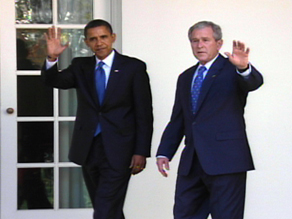
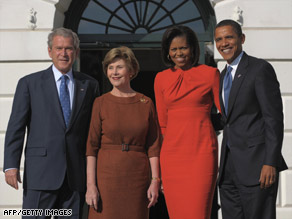
And here's some news footage of their arrival and the walk down the colonnade.
And live coverage from NBC:
Saturday, November 8, 2008
Where's the Pushover the GOP Promised Us?
Throughout the campaign, Obama's detractors suggested Obama would be a foreign policy pushover, talking with adversaries "without preconditions" and making a lot of hay out of Biden's comment that Obama would be tested early.
 So sorry! It's only Obama's fourth day of being President-Elect, and he's already miffed the Iranians with his firm stance, reiterated at his press conference yesterday, that a nuclear Iran is "unacceptable."
And now the Iranians are whining about Obama not being the pushover they hoped for, in a silly attempt to throw his message of change back into his face:
In other foreign policy news, CNN reports that Denis McDonough, Obama's senior foreign policy adviser, has clarified that contrary to a claim on the Polish president's website, Obama is not committed to a missile shield in Eastern Europe.
Russian President Dmitri Medvedev had warned earlier this week that the Russians would respond to the missile shield with missile deployments of their own near Poland.
 So sorry! It's only Obama's fourth day of being President-Elect, and he's already miffed the Iranians with his firm stance, reiterated at his press conference yesterday, that a nuclear Iran is "unacceptable."
And now the Iranians are whining about Obama not being the pushover they hoped for, in a silly attempt to throw his message of change back into his face:
[Parliamentary Speaker] Ali Larijani said Saturday that Obama should apply his campaign message of change to U.S. dealings with Iran.Lesson for the world: Obama is an intelligent, thoughtful leader who will listen respectfully to your point of view and discuss it with you. That's a lot more than Bush ever gave you. But don't think he's going to throw our national security out the window."Obama must know that the change that he talks about is not simply a superficial changing of colors or tactics," Larijani said in comments carried by the semi-official Mehr News Agency.
"What is expected is a change in strategy, not the repetition of objections to Iran's nuclear program, which will be taking a step in the wrong direction."
Source: CNN.com

In other foreign policy news, CNN reports that Denis McDonough, Obama's senior foreign policy adviser, has clarified that contrary to a claim on the Polish president's website, Obama is not committed to a missile shield in Eastern Europe.
Russian President Dmitri Medvedev had warned earlier this week that the Russians would respond to the missile shield with missile deployments of their own near Poland.
Obama Delivers the Weekly Democratic Address
Audio Streaming Source: Politico.com


Full Text of the Address:
On Tuesday, Americans stood in lines that stretched around schools and churches in numbers this nation has never seen. It didn’t matter who they were or where they came from; what they looked like or what party they belonged to – they came out and cast their ballot because they believed that in this country, our destiny is not written for us, but by us. We should all take pride in the fact that we once again displayed for the world the power of our democracy, and reaffirmed the great American ideal that this is a nation where anything is possible.
This week, I spoke with President Bush, who graciously offered his full support and assistance in this period of transition. Michelle and I look forward to meeting with him and the First Lady on Monday to begin that process. This speaks to a fundamental recognition that here in America we can compete vigorously in elections and challenge each other’s ideas, yet come together in service of a common purpose once the voting is done. And that is particularly important at a moment when we face the most serious challenges of our lifetime.
Yesterday, we woke to more sobering news about the state of our economy. The 240,000 jobs lost in October marks the 10th consecutive month that our economy has shed jobs. In total, we’ve lost nearly 1.2 million jobs this year, and more than 10 million Americans are now unemployed. Tens of millions of families are struggling to figure out how to pay the bills and stay in their homes. Their stories are an urgent reminder that we are facing the greatest economic challenge of our lifetime, and we must act swiftly to resolve them.
In the wake of these disturbing reports, I met with members of my Transition Economic Advisory Board, who will help guide the work of my transition team in developing a strong set of policies to respond to this crisis. While we must recognize that we only have one President at a time and that President Bush is the leader of our government, I want to ensure that we hit the ground running on January 20th because we don’t have a moment to lose.
We discussed several of the most immediate challenges facing our economy and key priorities on which to focus in the days and weeks ahead to ease the credit crisis, help hardworking families, and restore growth and prosperity.
First, we need a rescue plan for the middle class that invests in immediate efforts to create jobs and provides relief to families that are watching their paychecks shrink and their life savings disappear.
Then, we’ll address the spreading impact of the financial crisis on other sectors of our economy, and ensure that the rescue plan that passed Congress is working to stabilize financial markets while protecting taxpayers, helping homeowners, and not unduly rewarding the management of financial firms that are receiving government assistance.
Finally, we will move forward with a set of policies that will grow our middle-class and strengthen our economy in the long-term. We can’t afford to wait on moving forward on the key priorities that I identified during the campaign, including clean energy, health care, education and tax relief for middle class families.
Let me close by saying I do not underestimate the enormity of the task that lies ahead. We’ve taken some major actions to date, and we will need further actions during this transition and subsequent months. Some of those choices will be difficult, but America is a strong and resilient country. I know that we will succeed if we put aside partisanship and work together as one nation. And that is what I intend to do.
MP3 Download and Transcript Source: The Democratic Party
Friday, November 7, 2008
Obama holds his first press conference as President-Elect
Obama's remarks focus on his top priority, which is the same priority of the voters who sent him to the White House: the economy.
He's not the President yet, so he's a little hamstrung, and there's not a lot he can do himself yet. But he did call for a second stimulus package for the American people, which he said would be his first task as President, if it's not done sooner, which is what he hopes for.
(By the way, in the "Agenda" portion of the transition website, under the heading "Revitalizing the Economy," one finds reference to an Obama/Biden strategy to provide a $1,000 emergency energy rebate to Americans, paid for with a windfall profits tax on excessive oil company profits...that socialist sure doesn't waste any time, does he? But then, Sarah Palin does the same thing in Alaska, so I guess it's ok.)
Most interesting item in the press conference to me: He hedges a bit on raising taxes on upper-income Americans. (17:45 mark) Interesting...
Today he got his first "President-Elect version" of the PDB (President's Daily Briefing), the daily intelligence briefing normally delivered to the chief executive, which I heard he received at an FBI office in Chicago. He couldn't tell us anything about it, or he'd have to kill us.
My favorite line: "With respect to the dog [to be chosen for the Obama children], this is a major issue." (15:30 mark, based on question at 14:00 mark)
I love his dry sense of humor, able to talk as seriously and with as much thoughtfulness about the choice of a family dog as he does about fixing the economy. (And choosing the First Fido is important; you want a reliable guard dog who will keep the nasty paparazzi at bay, as the Bush dog Barney faithfully did yesterday.)
Courtesy of CSPAN and YouTube, here's the video of Obama's press conference today:
P.S. Obama had to call Nancy Reagan and apologize for his slightly mocking comment about her and seances, which he made at around 14:50. Reports are that the two had a warm conversation; sounds like Nancy took it in stride, and was as gracious as ever.
You can read a quick summary of the press conference here:
http://firstread.msnbc.msn.com/archive/2008/11/07/1663473.aspx
Full Transcript of the Press Conference:
Obama: Thank you very much, everybody. Thank you very much.
This morning, we woke up to more sobering news about the state of our economy. The 240,000 jobs lost in October marks the 10th consecutive month that our economy has shed jobs. In total, we've lost nearly 1.2 million jobs this year, and more than 10 million Americans are now unemployed.
Tens of millions of families are struggling to figure out how to pay the bills and stay in their homes. Their stories are an urgent reminder that we are facing the greatest economic challenge of our lifetime, and we're going to have to act swiftly to resolve it.
Now, the United States has only one government and one president at a time. And until January 20th of next year, that government is the current administration.
I've spoken to President Bush. I appreciate his commitment to ensuring that his economic policy team keeps us fully informed as developments unfold. And I'm also thankful for his invitation to the White House.
Immediately after I become president, I'm going to confront this economic crisis head on by taking all necessary steps to ease the credit crisis, help hardworking families, and restore growth and prosperity.
And this morning, I met with members of my Transition Economic Advisory Board, who are standing behind me, alongside my vice president-elect, Joe Biden.
They will help to guide the work of my transition team, working with Rahm Emanuel, my chief of staff, in developing a strong set of policies to respond to this crisis. We discussed in the earlier meeting several of the most immediate challenges facing our economy and key priorities on which to focus on in the days and weeks ahead.
First of all, we need a rescue plan for the middle class that invests in immediate efforts to create jobs and provide relief to families that are watching their paychecks shrink and their life savings disappear.
A particularly urgent priority is a further extension of unemployment insurance benefits for workers who cannot find work in the increasingly weak economy.
A fiscal stimulus plan that will jump-start economic growth is long overdue. I've talked about it throughout this -- the last few months of the campaign. We should get it done.
Second, we have to address the spreading impact of the financial crisis on the other sectors of our economy: small businesses that are struggling to meet their payrolls and finance their holiday inventories; and state and municipal governments facing devastating budget cuts and tax increases.
We must also remember that the financial crisis is increasingly global and requires a global response.
The news coming out of the auto industry this week reminds us of the hardship it faces, hardship that goes far beyond individual auto companies to the countless suppliers, small businesses and communities throughout our nation who depend on a vibrant American auto industry.
The auto industry is the backbone of American manufacturing and a critical part of our attempt to reduce our dependence on foreign oil.
I would like to see the administration do everything it can to accelerate the retooling assistance that Congress has already enacted. In addition, I have made it a high priority for my transition team to work on additional policy options to help the auto industry adjust, weather the financial crisis, and succeed in producing fuel-efficient cars here in the United States of America.
And I was glad to be joined today by Governor Jennifer Granholm, who obviously has great knowledge and great interest on this issue.
I've asked my team to explore what we can do under current law and whether additional legislation will be needed for this purpose.
 Third, we will review the implementation of this administration's financial program to ensure that the government's efforts are achieving their central goal of stabilizing financial markets while protecting taxpayers, helping homeowners, and not unduly rewarding the management of financial firms that are receiving government assistance.
It is absolutely critical that the Treasury work closely with the FDIC, HUD, and other government agencies to use the substantial authority that they already have to help families avoid foreclosure and stay in their homes.
Finally, as we monitor and address these immediate economic challenges, we will be moving forward in laying out a set of policies that will grow our middle class and strengthen our economy in the long term. We cannot afford to wait on moving forward on the key priorities that I identified during the campaign, including clean energy, health care, education, and tax relief for middle-class families.
My transition team will be working on each of these priorities in the weeks ahead, and I intend to reconvene this advisory board to discuss the best ideas for responding to these immediate problems.
Let me close by saying this. I do not underestimate the enormity of the task that lies ahead. We have taken some major action to date, and we will need further action during this transition and subsequent months.
Some of the choices that we make are going to be difficult. And I have said before and I will repeat again: It is not going to be quick, and it is not going to be easy for us to dig ourselves out of the hole that we are in.
But America is a strong and resilient country. And I know we will succeed, if we put aside partisanship and politics and work together as one nation. That's what I intend to do.
With that, let me open it up for some questions. And I'm going to start right here with you.
Question: Thank you, Mr. President-elect. I wonder what you think any president can accomplish during their first 100 days in office to turn the economy around? How far can you go? And what will be your priorities on day one?
Obama: Well, I think that a new president can do an enormous amount to restore confidence, to move an agenda forward that speaks to the needs of the economy and the needs of middle-class families all across the country.
I've outlined during the course of the campaign some critical issues that I intend to work on.
We have a current financial crisis that is spilling out into rest of the economy, and we have taken some action so far. More action is undoubtedly going to be needed. My transition team is going to be monitoring very closely what happens over the course of the next several months.
The one thing I can say with certainty is that we are going to need to see a stimulus package passed either before or after inauguration.
We are going to have to focus on jobs, because the hemorrhaging of jobs has an impact, obviously, on consumer confidence and the ability of people to -- to buy goods and services and can have enormous spillover effects.
And I think it's going to be very important for us to provide the kinds of assistance to state and local governments to make sure that they don't compound some of the problems that are already out there by having to initiate major layoffs or initiate tax increases.
So there are some things that we know we're going to have to do, but I'm confident that a new president can have an enormous impact. That's why I ran for president.
Question: (off-mike) ... from House Democrats that the stimulus package may be in trouble, that it's going to be a hard time getting out of a lame-duck session. Are you still confident that you would be able to get something done before you actually take office?
Obama: I want to see a stimulus package sooner rather than later. If it does not get done in the lame-duck session, it will be the first thing I get done as president of the United States.
Question: Senator, for the first time since the Iranian revolution, the president of Iran sent a congratulations note to a new U.S. president. I'm wondering if, first of all, if you responded to President Ahmadinejad's note of congratulations and, second of all, and more importantly, how soon do you plan on sending low-level envoys to countries such as Iran, Syria, Venezuela, Cuba, to see if a presidential-level talk would be productive?
Obama: I am aware that the letter was sent. Let me state -- repeat what I stated during the course of the campaign.
Iran's development of a nuclear weapon I believe is unacceptable. And we have to mount a international effort to prevent that from happening.
Iran's support of terrorist organizations I think is something that has to cease.
I will be reviewing the letter from President Ahmadinejad, and we will respond appropriately. It's only been three days since the election. Obviously, how we approach and deal with a country like Iran is not something that we should, you know, simply do in a knee- jerk fashion. I think we've got to think it through.
But I have to reiterate once again that we only have one president at a time. And I want to be very careful that we are sending the right signals to the world as a whole that I am not the president and I won't be until January 20th.
Question: Picking up what we were just talking about, your meeting with President Bush on Monday. When -- he is still the decider, obviously, stating the obvious. When you disagree with decisions he makes, will you defer? Will you challenge? Will you confront? And if it becomes confrontational, could that rattle the markets even more?
Obama: Well, President Bush graciously invited Michelle and I to -- to meet with him and First Lady Laura Bush. We are gratified by the invitation. I'm sure that, in addition to taking a tour of the White House, there's going to be a substantive conversation between myself and the president.
I'm not going to anticipate problems. I'm going to go in there with a spirit of bipartisanship and a sense that both the president and various leaders in Congress all recognize the severity of the situation right now and want to get stuff done.
And, you know, undoubtedly there may end up being differences between not just members of different parties, but between people within the same party.
The critical point and I think the critical tone that has to be struck by all of us involved right now is the American people need help. This economy is in bad shape. And we have just completed one of the longest election cycles in recorded history.
Now is a good time for us to set politics aside for a while and think practically about what will actually work to move the economy forward. And it's in that spirit that I'll have the conversation with the president.
Question: Thank you, Mr. President-elect. With the country facing two wars and a financial crisis, do you think it's important for you to move especially quickly to fill key cabinet posts, such as treasury secretary and secretary of state?
Obama: When we have an announcement about cabinet appointments, we will make them. There is no doubt that I think people want to know who's going to make up our team.
And I want to move with all deliberate haste, but I want to emphasize "deliberate" as well as "haste." I'm proud of the choice I made of vice president, partly because we did it right. I'm proud of the choice of chief of staff, because we thought it through.
And I think it's very important, in all these key positions, both in the economic team and the national security team, to -- to get it right and not to be so rushed that you end up making mistakes.
I'm confident that we're going to have an outstanding team, and we will be rolling that out in subsequent weeks.
Question: Yes, sir. To what extent -- to what extent are you planning to use your probably pretty great influence in determining the successor for your Senate seat? And what sort of criteria should the governor be looking at in filling that position?
Obama: This is the governor's decision; it is not my decision.
And I think that the criteria that I would have for my successor would be the same criteria that I'd have if I were a voter: somebody who is capable; somebody who is passionate about helping working families in Illinois meet their -- meet their dreams.
And I think there are going to be a lot of good choices out there, but it is the governor's decision to make, not mine.
Lynn Sweet?
Question: Mr. President-elect ...
Obama: What happened to your arm, Lynn?
Question: I cracked my shoulder running to your speech on election night.
Obama: Oh, no.
(Laughter)
Question: (inaudible)
Obama: I think that was the only major incident during the -- the entire Grant Park celebration.
Question: Thank you for asking. Here's my question. I'm wondering what you're doing to get ready. Have you spoke to any living ex-presidents, what books you might be reading?
Everyone wants to know, what kind of dog are you going to buy for your girls? Have you decided on a private or public school for your daughters?
Obama: Let -- let me list those off.
In terms of speaking to former presidents, I've spoken to all of them that are living. Obviously, President Clinton -- I didn't want to get into a Nancy Reagan thing about, you know, doing any seances.
I have re-read some of Lincoln's writings, who's always an extraordinary inspiration.
And, by the way, President Carter, President Bush, Sr., as well as the current president have all been very gracious and offered to provide any help that they can in this transition process.
With respect to the dog, this is a major issue. I think it's generated more interest on our Web site than just about anything.
We have -- we have two criteria that have to be reconciled. One is that Malia is allergic, so it has to be hypoallergenic. There are a number of breeds that are hypoallergenic.
On the other hand, our preference would be to get a shelter dog, but, obviously, a lot of shelter dogs are mutts like me. So -- so whether we're going to be able to balance those two things I think is a pressing issue on the Obama household.
And with respect to schools, Michelle will be -- will be scouting out some schools. We'll be making a decision about that in the future.
Question: You are now privy to a lot of intelligence that you haven't had access to before, in fact, much of what the president sees, I'm sure all of it.
First of all, do you -- what do you think about the state of U.S. intelligence, whether you think it needs beefing up, whether you think there's enough interaction between the various agencies?
And, second of all, has anything that you've heard given you pause about anything you've talked about on the campaign trail?
Obama: Well, as you know, if -- if there was something I had heard, I couldn't tell you. But...
Question: (off-mike)
Obama: I have received intelligence briefings. And I will make just a general statement.
Our intelligence process can always improve. I think it has gotten better. And, you know, beyond that, I don't think I should comment on the nature of the intelligence briefings.
That was a two-parter. Was there another aspect to that?
Question: Well, just whether -- you know, absent what you've heard...
Obama: OK, I get you.
Question: ... whether anything has given you pause.
Obama: I'm going to skip that.
Question: Mr. President-elect, do you still intend to seek income tax increases for upper-income Americans? And if so, should these Americans expect to pay higher taxes in 2009?
Obama: The -- my tax plan represented a net tax cut. It provided for substantial middle-class tax cuts; 95 percent of working Americans would receive them.
It also provided for cuts in capital gains for small businesses, additional tax credits. All of it is designed for job growth.
My priority is going to be, how do we grow the economy? How do we create more jobs?
I think that the plan that we've put forward is the right one, but, obviously, over the next several weeks and months, we're going to be continuing to take a look at the data and see what's taking place in the economy as a whole.
Source: AP/CNN.com.
He's not the President yet, so he's a little hamstrung, and there's not a lot he can do himself yet. But he did call for a second stimulus package for the American people, which he said would be his first task as President, if it's not done sooner, which is what he hopes for.
(By the way, in the "Agenda" portion of the transition website, under the heading "Revitalizing the Economy," one finds reference to an Obama/Biden strategy to provide a $1,000 emergency energy rebate to Americans, paid for with a windfall profits tax on excessive oil company profits...that socialist sure doesn't waste any time, does he? But then, Sarah Palin does the same thing in Alaska, so I guess it's ok.)
Most interesting item in the press conference to me: He hedges a bit on raising taxes on upper-income Americans. (17:45 mark) Interesting...
Today he got his first "President-Elect version" of the PDB (President's Daily Briefing), the daily intelligence briefing normally delivered to the chief executive, which I heard he received at an FBI office in Chicago. He couldn't tell us anything about it, or he'd have to kill us.
My favorite line: "With respect to the dog [to be chosen for the Obama children], this is a major issue." (15:30 mark, based on question at 14:00 mark)
I love his dry sense of humor, able to talk as seriously and with as much thoughtfulness about the choice of a family dog as he does about fixing the economy. (And choosing the First Fido is important; you want a reliable guard dog who will keep the nasty paparazzi at bay, as the Bush dog Barney faithfully did yesterday.)
Courtesy of CSPAN and YouTube, here's the video of Obama's press conference today:
P.S. Obama had to call Nancy Reagan and apologize for his slightly mocking comment about her and seances, which he made at around 14:50. Reports are that the two had a warm conversation; sounds like Nancy took it in stride, and was as gracious as ever.
You can read a quick summary of the press conference here:
http://firstread.msnbc.msn.com/archive/2008/11/07/1663473.aspx
Full Transcript of the Press Conference:
Obama: Thank you very much, everybody. Thank you very much.
This morning, we woke up to more sobering news about the state of our economy. The 240,000 jobs lost in October marks the 10th consecutive month that our economy has shed jobs. In total, we've lost nearly 1.2 million jobs this year, and more than 10 million Americans are now unemployed.
Tens of millions of families are struggling to figure out how to pay the bills and stay in their homes. Their stories are an urgent reminder that we are facing the greatest economic challenge of our lifetime, and we're going to have to act swiftly to resolve it.
Now, the United States has only one government and one president at a time. And until January 20th of next year, that government is the current administration.
I've spoken to President Bush. I appreciate his commitment to ensuring that his economic policy team keeps us fully informed as developments unfold. And I'm also thankful for his invitation to the White House.
Immediately after I become president, I'm going to confront this economic crisis head on by taking all necessary steps to ease the credit crisis, help hardworking families, and restore growth and prosperity.
And this morning, I met with members of my Transition Economic Advisory Board, who are standing behind me, alongside my vice president-elect, Joe Biden.
They will help to guide the work of my transition team, working with Rahm Emanuel, my chief of staff, in developing a strong set of policies to respond to this crisis. We discussed in the earlier meeting several of the most immediate challenges facing our economy and key priorities on which to focus on in the days and weeks ahead.
First of all, we need a rescue plan for the middle class that invests in immediate efforts to create jobs and provide relief to families that are watching their paychecks shrink and their life savings disappear.
A particularly urgent priority is a further extension of unemployment insurance benefits for workers who cannot find work in the increasingly weak economy.
A fiscal stimulus plan that will jump-start economic growth is long overdue. I've talked about it throughout this -- the last few months of the campaign. We should get it done.
Second, we have to address the spreading impact of the financial crisis on the other sectors of our economy: small businesses that are struggling to meet their payrolls and finance their holiday inventories; and state and municipal governments facing devastating budget cuts and tax increases.
We must also remember that the financial crisis is increasingly global and requires a global response.
The news coming out of the auto industry this week reminds us of the hardship it faces, hardship that goes far beyond individual auto companies to the countless suppliers, small businesses and communities throughout our nation who depend on a vibrant American auto industry.
The auto industry is the backbone of American manufacturing and a critical part of our attempt to reduce our dependence on foreign oil.
I would like to see the administration do everything it can to accelerate the retooling assistance that Congress has already enacted. In addition, I have made it a high priority for my transition team to work on additional policy options to help the auto industry adjust, weather the financial crisis, and succeed in producing fuel-efficient cars here in the United States of America.
And I was glad to be joined today by Governor Jennifer Granholm, who obviously has great knowledge and great interest on this issue.
I've asked my team to explore what we can do under current law and whether additional legislation will be needed for this purpose.
 Third, we will review the implementation of this administration's financial program to ensure that the government's efforts are achieving their central goal of stabilizing financial markets while protecting taxpayers, helping homeowners, and not unduly rewarding the management of financial firms that are receiving government assistance.
It is absolutely critical that the Treasury work closely with the FDIC, HUD, and other government agencies to use the substantial authority that they already have to help families avoid foreclosure and stay in their homes.
Finally, as we monitor and address these immediate economic challenges, we will be moving forward in laying out a set of policies that will grow our middle class and strengthen our economy in the long term. We cannot afford to wait on moving forward on the key priorities that I identified during the campaign, including clean energy, health care, education, and tax relief for middle-class families.
My transition team will be working on each of these priorities in the weeks ahead, and I intend to reconvene this advisory board to discuss the best ideas for responding to these immediate problems.
Let me close by saying this. I do not underestimate the enormity of the task that lies ahead. We have taken some major action to date, and we will need further action during this transition and subsequent months.
Some of the choices that we make are going to be difficult. And I have said before and I will repeat again: It is not going to be quick, and it is not going to be easy for us to dig ourselves out of the hole that we are in.
But America is a strong and resilient country. And I know we will succeed, if we put aside partisanship and politics and work together as one nation. That's what I intend to do.
With that, let me open it up for some questions. And I'm going to start right here with you.
Question: Thank you, Mr. President-elect. I wonder what you think any president can accomplish during their first 100 days in office to turn the economy around? How far can you go? And what will be your priorities on day one?
Obama: Well, I think that a new president can do an enormous amount to restore confidence, to move an agenda forward that speaks to the needs of the economy and the needs of middle-class families all across the country.
I've outlined during the course of the campaign some critical issues that I intend to work on.
We have a current financial crisis that is spilling out into rest of the economy, and we have taken some action so far. More action is undoubtedly going to be needed. My transition team is going to be monitoring very closely what happens over the course of the next several months.
The one thing I can say with certainty is that we are going to need to see a stimulus package passed either before or after inauguration.
We are going to have to focus on jobs, because the hemorrhaging of jobs has an impact, obviously, on consumer confidence and the ability of people to -- to buy goods and services and can have enormous spillover effects.
And I think it's going to be very important for us to provide the kinds of assistance to state and local governments to make sure that they don't compound some of the problems that are already out there by having to initiate major layoffs or initiate tax increases.
So there are some things that we know we're going to have to do, but I'm confident that a new president can have an enormous impact. That's why I ran for president.
Question: (off-mike) ... from House Democrats that the stimulus package may be in trouble, that it's going to be a hard time getting out of a lame-duck session. Are you still confident that you would be able to get something done before you actually take office?
Obama: I want to see a stimulus package sooner rather than later. If it does not get done in the lame-duck session, it will be the first thing I get done as president of the United States.
Question: Senator, for the first time since the Iranian revolution, the president of Iran sent a congratulations note to a new U.S. president. I'm wondering if, first of all, if you responded to President Ahmadinejad's note of congratulations and, second of all, and more importantly, how soon do you plan on sending low-level envoys to countries such as Iran, Syria, Venezuela, Cuba, to see if a presidential-level talk would be productive?
Obama: I am aware that the letter was sent. Let me state -- repeat what I stated during the course of the campaign.
Iran's development of a nuclear weapon I believe is unacceptable. And we have to mount a international effort to prevent that from happening.
Iran's support of terrorist organizations I think is something that has to cease.
I will be reviewing the letter from President Ahmadinejad, and we will respond appropriately. It's only been three days since the election. Obviously, how we approach and deal with a country like Iran is not something that we should, you know, simply do in a knee- jerk fashion. I think we've got to think it through.
But I have to reiterate once again that we only have one president at a time. And I want to be very careful that we are sending the right signals to the world as a whole that I am not the president and I won't be until January 20th.
Question: Picking up what we were just talking about, your meeting with President Bush on Monday. When -- he is still the decider, obviously, stating the obvious. When you disagree with decisions he makes, will you defer? Will you challenge? Will you confront? And if it becomes confrontational, could that rattle the markets even more?
Obama: Well, President Bush graciously invited Michelle and I to -- to meet with him and First Lady Laura Bush. We are gratified by the invitation. I'm sure that, in addition to taking a tour of the White House, there's going to be a substantive conversation between myself and the president.
I'm not going to anticipate problems. I'm going to go in there with a spirit of bipartisanship and a sense that both the president and various leaders in Congress all recognize the severity of the situation right now and want to get stuff done.
And, you know, undoubtedly there may end up being differences between not just members of different parties, but between people within the same party.
The critical point and I think the critical tone that has to be struck by all of us involved right now is the American people need help. This economy is in bad shape. And we have just completed one of the longest election cycles in recorded history.
Now is a good time for us to set politics aside for a while and think practically about what will actually work to move the economy forward. And it's in that spirit that I'll have the conversation with the president.
Question: Thank you, Mr. President-elect. With the country facing two wars and a financial crisis, do you think it's important for you to move especially quickly to fill key cabinet posts, such as treasury secretary and secretary of state?
Obama: When we have an announcement about cabinet appointments, we will make them. There is no doubt that I think people want to know who's going to make up our team.
And I want to move with all deliberate haste, but I want to emphasize "deliberate" as well as "haste." I'm proud of the choice I made of vice president, partly because we did it right. I'm proud of the choice of chief of staff, because we thought it through.
And I think it's very important, in all these key positions, both in the economic team and the national security team, to -- to get it right and not to be so rushed that you end up making mistakes.
I'm confident that we're going to have an outstanding team, and we will be rolling that out in subsequent weeks.
Question: Yes, sir. To what extent -- to what extent are you planning to use your probably pretty great influence in determining the successor for your Senate seat? And what sort of criteria should the governor be looking at in filling that position?
Obama: This is the governor's decision; it is not my decision.
And I think that the criteria that I would have for my successor would be the same criteria that I'd have if I were a voter: somebody who is capable; somebody who is passionate about helping working families in Illinois meet their -- meet their dreams.
And I think there are going to be a lot of good choices out there, but it is the governor's decision to make, not mine.
Lynn Sweet?
Question: Mr. President-elect ...
Obama: What happened to your arm, Lynn?
Question: I cracked my shoulder running to your speech on election night.
Obama: Oh, no.
(Laughter)
Question: (inaudible)
Obama: I think that was the only major incident during the -- the entire Grant Park celebration.
Question: Thank you for asking. Here's my question. I'm wondering what you're doing to get ready. Have you spoke to any living ex-presidents, what books you might be reading?
Everyone wants to know, what kind of dog are you going to buy for your girls? Have you decided on a private or public school for your daughters?
Obama: Let -- let me list those off.
In terms of speaking to former presidents, I've spoken to all of them that are living. Obviously, President Clinton -- I didn't want to get into a Nancy Reagan thing about, you know, doing any seances.
I have re-read some of Lincoln's writings, who's always an extraordinary inspiration.
And, by the way, President Carter, President Bush, Sr., as well as the current president have all been very gracious and offered to provide any help that they can in this transition process.
With respect to the dog, this is a major issue. I think it's generated more interest on our Web site than just about anything.
We have -- we have two criteria that have to be reconciled. One is that Malia is allergic, so it has to be hypoallergenic. There are a number of breeds that are hypoallergenic.
On the other hand, our preference would be to get a shelter dog, but, obviously, a lot of shelter dogs are mutts like me. So -- so whether we're going to be able to balance those two things I think is a pressing issue on the Obama household.
And with respect to schools, Michelle will be -- will be scouting out some schools. We'll be making a decision about that in the future.
Question: You are now privy to a lot of intelligence that you haven't had access to before, in fact, much of what the president sees, I'm sure all of it.
First of all, do you -- what do you think about the state of U.S. intelligence, whether you think it needs beefing up, whether you think there's enough interaction between the various agencies?
And, second of all, has anything that you've heard given you pause about anything you've talked about on the campaign trail?
Obama: Well, as you know, if -- if there was something I had heard, I couldn't tell you. But...
Question: (off-mike)
Obama: I have received intelligence briefings. And I will make just a general statement.
Our intelligence process can always improve. I think it has gotten better. And, you know, beyond that, I don't think I should comment on the nature of the intelligence briefings.
That was a two-parter. Was there another aspect to that?
Question: Well, just whether -- you know, absent what you've heard...
Obama: OK, I get you.
Question: ... whether anything has given you pause.
Obama: I'm going to skip that.
Question: Mr. President-elect, do you still intend to seek income tax increases for upper-income Americans? And if so, should these Americans expect to pay higher taxes in 2009?
Obama: The -- my tax plan represented a net tax cut. It provided for substantial middle-class tax cuts; 95 percent of working Americans would receive them.
It also provided for cuts in capital gains for small businesses, additional tax credits. All of it is designed for job growth.
My priority is going to be, how do we grow the economy? How do we create more jobs?
I think that the plan that we've put forward is the right one, but, obviously, over the next several weeks and months, we're going to be continuing to take a look at the data and see what's taking place in the economy as a whole.
Source: AP/CNN.com.
Subscribe to:
Posts (Atom)


